



 Church, state and money: How Italy subsidises the Vatican (2007-2018)
The Vatican Secretary of State objected to the publication of these groundbreaking articles, but did not dispute their accuracy. Here is the complete series specially translated from La Repubblica by Graeme A. Hunter. In response to this scandal in 2012 the European Court of Justice obliged Italy to close a loophole allowed the Vatican and religious orders to avoid property tax on commercial activities as long as the premises contained a chapel. And in 2018 it ruled that the Vatcan must pay Italy €4 billion for the unpaid taxes during the five years from 2006 to 2011.The next question is, will the Vatican actually hand over the money?
 Summary: The Vatican owns far more of Italy than its walled enclave in the city of Rome. Through its vast holdings which include shipping ports, rental properties, hotels, sporting arenas and other commercial enterprises, it actually owns a fifth of Italy. [1] Yet this is mostly exempt from Italian property tax. This represents not only a huge subsidy to the Vatican by the taxpayers of Italy, it also gives Vatican-owned businesses an unfair advantage over competitors who pay their taxes. Accordingly, in 2007 the European Commission began — very gingerly — investigating Italy for giving the Church unfair tax breaks. The Vatican was briefly worried enough to suggest revising the concordat. [2] However, after the Vatican and Italy combined to put pressure on the EU Commissioner for Competition, he dropped the matter — twice. In 2012 the EU finally ruled that tax exemptions for Church-run businesses broke European competition rules. [3]
This ruling closed the loophole, but what about all the back taxes that the Vatican had dodged? Even though Italy was on an austerity budget, Prime Minister Monti said the Vatican should be excused from paying back to his country the taxes avoided through the unfair loophole. [4] So it was left to the EU to help the Italian people by insisting that their government collect the taxes that were due to the nation. In 2018, therefore, the European Court of Justice ruled that the Vatican must pay €4 billion for unpaid taxes on its Italian hospitals, schools and hotels. The judgement covered the five years from 2006 to 2011 when Italian law allowed the Vatican and religious orders to avoid property tax on commercial activities as long as the premises contained a chapel. [5]
Update 2012: Italy wants no back taxes from Vatican
Even the Italian austerity budget preserved tax exemptions for Church-run businesses. However, after these were found to breach European competition rules, Prime Minister Monti said the Vatican should at least be excused from paying back taxes to his country.
Property tax relief for the Church: EU takes Italy to court
If the Catholic Church places a little shrine in one of its businesses, a cinema, shop, restaurant or hotel, it escapes paying 90% of what it owes to the state for its commercial activities. This is because Italian tax laws exempt anything “not exclusively commercial”, an “intentional loophole” to favour the Church. (“La Ue pronta a processare : gli sconti Ici alla Chiesa", di Curzio Maltese, La Repubblica, 25 giugno 2007) [This was shelved, but a third attempt was made to launch an investigation in 2010 — see next story.]
Italian and Vatican pressure overcome by threat to go before the European Court
Under under intense pressure from both the Italian Government and the Vatican, European Union Commissioner for Competition dropped the matter twice. However the complainants threatened to go before the European Court of Justice and now the process against Italy for giving unfair tax breaks to the Church is going ahead. (“Sconto Ici alla Chiesa : la Ue processa l'Italia”, di Alberto d'Argenio, La Repubblica, 24 settembre 2010)
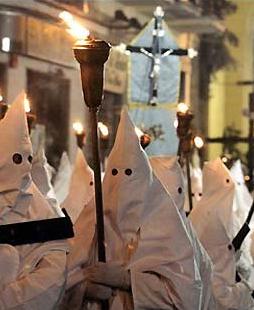 ‘Voluntary’ Contributions for State Aid Projects Finish Up in Church Coffers
Two-thirds of the “voluntary” tax contributions go to the Church, despite taxpayers wanting it to go to the state. For example, instead of funding “humanitarian, voluntary work and non-religious purposes including cultural assets” €369,000 of the tax money from those who ticked the “secular” box was given to the Brotherhood of Saint Mary’s Purity. Its task is to conduct the Holy Saturday part of the “Procession of Mary’s Desolation” in Gallipoli. The Brothers wear long white penitentiary robes, short yellow cloaks and peaked hoods with eyeholes, as they parade to the sound of a funeral march bearing torches, statues of the Virgin, heavy wooden crosses and even rocks. (“L’8 per mille dello Stato? Va alla Chiesa” di Carmelo Lopapa, La Repubblica, 17 novembre 2009)
The Church's accounts: here's how much it costs us
Cardinal Camillo Ruini, who heads the Italian Bishops Conference uses the vast sums from the “church tax” to stifle dissent even within Church. When this is combined with all the other tax breaks and outright subsidies, at a “conservative” reckoning the Catholic Church costs the taxpayers of Italy more than the whole overblown state bureaucracy. Yet the Church is neither elected by the people, nor subject to the democratic process. (“I conti della Chiesa : ecco quanto ci costa”, di Curzio Maltese, La Repubblica, 28 settembre 2007)
Tax crusade marches on the holy hotels
Since 1992 the Catholic Church has been able to exploit a tax exemption and hostels, colleges and convents into modern hotels. “Churches are emptying while religious hotels are filling up.” The nuns who staff them are paid through the “church tax”, and the profits from these enterprises contribute to the 4 billion Euros, much of which “disappears into a power machine which influences and grooms the economy, politics, democracy and sometimes the exercise of constitutional rights, amongst which is freedom of the press”. (“Gli alberghi dei santi : alla crociata dell'Ici”, di Curzio Maltese, La Repubblica, 25 ottobre 2007)
Religious dogma in the classroom: RE classes are worth a billion
The Italian Constitution (Article 33) prohibits state funding for Catholic private schools, yet this still done. And in the state schools Catholic Religious Education teachers, though are appointed by the bishops, are subsidised by the taxpayers. And if the Church fires an RE teacher for “sins” like being separated, the state must pay the ex-RE teacher until retirement. Grants from the state for Catholic RE amount to almost as much as the “church tax” itself. (“Religione, il dogma in aula : un'ora che vale un miliardo”, di Curzio Maltese, La Repubblica, 25 ottobre 2007)
The Church has a secret tax fund: this is where a billion Euros disappear to
The majority of Church funding comes from a clever mechanism invented by a Bishop Attilio Nicora who, after a discreet interval, was rewarded with a cardinal's hat. This gives the lion's share to the Catholic Church, even of the taxes of those who didn't specify where their contribution should go. Yet only a small fraction of this is used for charity. (“Chiesa, c'è un 8 per mille segreto: Ecco dove finisce un miliardo di euro”, di Curzio Maltese, La Repubblica, 25 ottobre 2007)
Religion and democracy
Cardinal Bertone, the Secretary of State for the Holy See (Vatican) has condemned La Repubblica's series: “Let’s put an end to this tale about Church finances”. The newspaper, however, intends to continue its investigation. (“Democrazia e religione” di Ezio Mauro, La Repubblica, 25 ottobre 2007)
God's tourists: 5 billion Euros a year
With religious tourism growing by 20% a year, the Catholic Church is now offering flights in through ORP, the “Roman Pilgrimage Office”. ORP is based in the Vatican City and therefore “enjoys off-shore tax status, which in practice means that they don't have to submit accounts and can bypass Italian tax, hygiene and safety laws, to name but a few.” (“Turisti nel nome di Dio : un affare da 5 miliardi”, Di Curzio Maltese, La Repubblica, 10 novembre 2007)
Note: While Italy gives the Vatican travel agency, ORP, tax breaks, Nigeria directly pays it to instruct and bring Nigerians to Rome. Since 2007 Nigeria had been assisting and subsidising its Muslim pilgrims to Mecca and its Christian ones to Jerusalem. Then in 2011 the Vatican managed to get Rome added to the Christian pilgrimage, with an agreement between the Nigerian government and ORP to cement the payments. A priest from ORP says that much of work with the Nigerian pilgrims of various denominations is “evangelisation” ― which is now being funded by their own government. [6]
Church uses Public Money for the Common Good: Italy should be grateful
The director of the Vatican tourist operation, the “Pilgrimage Office”, claims that public funds and tax breaks are not privileges. He says that Church has rescued the Italian tourist industry from political neglect, and has been “delegated" by the government to take care of immigrants and the poor. And, oh yes, the Church is a victim and must try to protect itself “from those would exploit holy sites and believers merely for financial gain”. (“Usiamo gli aiuti per il bene comune : l'Italia dovrebbe ringraziare la Chiesa” di Curzio Maltese, La Repubblica, 28 novembre 2007)
Charity: The other side of our Donations
The Italian Church provides service in exchange for state funds. The social welfare system is being dismantled bit by bit and handed over to the Church: rights are being replaced by charity. A very independent social worker priest offers implicit criticism of this development: “In forty years I have learned that a happy society is one with less solidarity and more rights.... The question is about regaining more justice and not offering as charity things which people should have a right to”. (“Carità, l'altra faccia dell'obolo : così la Chiesa sostituisce lo Stato”, di Curzio Maltese, La Repubblica, 17 dicembre 2007)
The Secrets of the Vatican Bank
The President of the Vatican Bank admits that it offers secret accounts to many who “have had problems with the law”. There are no cheque books. Everything is done by transfer, by cash or in gold bullion. Untraceable. And, as if the nine-metre thick walls of its tower in the Vatican did not offer enough privacy, it appears to have quietly established itself in the offshore financial centre of the Cayman Islands. (“Scandali, affari e misteri : tutti i segreti dello Ior”, di Curzio Maltese,
La Repubblica, 26 gennaio 2008)
Note: The Italian "church tax" obliges residents to devote 0.8 % (otto per mille) of their taxes either to the State or to one of the five officially recognized religions. In practice, this means that although only 40 % of Italian taxpayers actually designate the Catholic Church as the recipient of their church tax, the taxes of almost 90% of them wind up in the Church coffers. For more, see the introduction and notes to the 1984 concordat.
About this ground-breaking La Repubblica series
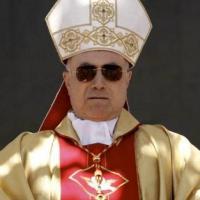 When Cardinal Ratzinger served as doctrinal watchdog, his second-in-command was Cardinal Bertone. When he became Pope Benedict XVI, he continued to hand difficult problems to his trusted trouble-shooter, whom he appointed Secretary of State. Thus Bertone was assigned to rein in the Fatima renegades who think the Church is involved in a plot to conceal the real message of the Blessed Virgin. The redoubtable Cardinal was also in charge of holding the uxorious Archbishop Milingo of Zambia in a secluded convent south of Rome, far away from both temptations and the press. (The unrepentant Archbishop gave him the slip.*) And he was assigned to rein in La Repubblica, Italy's largest newspaper, for publishing this series on Church finances. Accordingly Cardinal Bertone issued a peremptory “Let's stop this”.
However, he didn't dispute the figures, but could only object that it's not proper to discuss the financial aspects of things that are “sacrosanct”. This worked in the past, but the days are over when a paper automatically obeyed a cardinal, and La Repubblica promised to continue its investigative series.
However, within the Vatican, Bertone is still safe, even in retirement. In 2107 Church (not Italian) prosecutors charged the former president and treasurer of the Vatican’s children’s hospital for allegedly embezzling €422,000 to redecorate the penthouse apartment of Cardinal Bertone. Naturally, the Cardinal himself wasn't charged with anything.**
* Philip Pullella, “Vatican defrocks exorcist archbishop who married”, Reuters, 17 December 2009. http://www.reuters.com/article/2009/12/17/us-pope-milingo-idUSTRE5BG24T20091217
** “Cash scandal at Vatican’s child hospita”, The Times, 14 July 2017. https://www.thetimes.co.uk/article/cash-scandal-at-vatican-s-child-hospital-8g5hx5cvn?shareToken=064e92fcc0ad27b1ce452055beedc944
Related articles
“Italy corruption scandal taints the Vatican”, Reuters, 20 June 2010.
“Vatican pledges to help police in cardinal corruption probe”, Irish Independent, 21 June 2010.
For an analysis of what it means when the Vatican Bank begins to be expected to observe normal banking practices, see from the New York Times, “With Bank Inquiry, Vatican Confronts Modern Life”.
Notes
1. “EU appointed Italian gov’t tries to strip Catholic Church’s property tax exemption”, Life Site News, 23 October 2012. http://www.lifesitenews.com/news/eu-appointed-italian-govt-tries-to-strip-catholic-churchs-property-tax-exem
2. John Hooper, “Church ready to forgo tax breaks”, Guardian, 28 August 2007. http://www.guardian.co.uk/world/2007/aug/28/italy.johnhooper
3. “Discounts for the Church ― EU puts Italy on trial” (“Sconto Ici alla Chiesa: la Ue processa l'Italia”), La Repubblica, 24 September 2010. http://www.concordatwatch.eu/kb-37001.843
4. Michael Day, “Vatican told to pay taxes as Italy tackles budget crisis”, Independent, 17 February 2012. http://www.independent.co.uk/news/world/europe/vatican-told-to-pay-taxes-as-italy-tackles-budget-crisis-6988938.html
5. Tom Kington, “Vatican faces €4bn property tax bill”, Times, 7 November 2018. https://www.thetimes.co.uk/article/vatican-faces-4bn-property-tax-bill-zhd22jb2d?shareToken=3a99ef57c1dab727b411091dbf241d6a
6. “Another Lesson From Africa: Government-Funded Pilgrimage”, Zenit, 26 April 2012. http://www.zenit.org/article-34676?l=english
“Nigerian Christian pilgrims come to Rome”, Vatican Radio, 26 April 2012. http://www.oecumene.radiovaticana.org/en1/Articolo.asp?c=582951

