



 How the Lateran Treaty made the Catholic Church into a state
Mussolini's boasted that the Lateran Treaty would “bury” the worldly power of the pope, but it permitted just the opposite, even serving as a springboard to vault the Church into international bodies. And as a comedienne discovered in 2008, this Treaty still threatens Italians with five years in prison for a joke about the Pope.
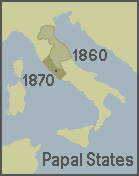 Until 1860 Pope Pius IX ruled over his Papal States which stretched across the Italian peninsula, dividing it in two. The following year, when urged to accept a peaceful settlement to avoid an armed assault he indignantly refused. Even after the Pope’s subjects voted overwhelmingly to join Italy, he remained adamant: “This corner of the earth is mine; I received it from Christ”. [1]
In 1871 Italy was finally unified by absorbing the Papal States. The Pope, now deposed as King of Rome, retreated behind the walls of the Vatican, where he continued to fight the Italian state with every means at his disposal.
He excommunicated the King of Italy. He had long railed against the secular values of the Italian kingdom. In his 1864 Syllabus of Errors he had already condemned more than eighty “errors and perverse doctrines” including separation of church and state, a free press and secular education. Most Italians understood such “errors” to be presented “as a none too oblique condemnation of the Italian Kingdom”. [2] Pope Pius IX also directly forbade Catholics to participate by way of voting or any political involvement in the workings of the “godless” Italian state.
After the unification of Italy, for 58 years a succession of popes refused to acknowledge the new country that had swallowed up the papal kindom. They refused to even set foot on its soil. With pathos Pius IX depicted his own boycott as a tale of persecution and talked of being a “prisoner in the Vatican”.
In 1929 the long wait finally paid off when Mussolini proved willing to enter an alliance with the Vatican. A precondition of the negotiations was destruction of the parliamentary Catholic Italian Popular Party. Pius XI disliked political Catholicism because he could not control it. Like his predecessors, he believed that Catholic party politics brought democracy into the church by the back door. The demise of the Popular Party caused a wholesale shift of Catholics into the Fascist Party and the collapse of democracy in Italy. [3] A few years later the Pius would follow the same concordat strategy with Hitler to disband the democratic Catholic party there. Eliminating the Catholic Centre-right party helped give Hitler the majority he needed in the last free election before he shut down German democracy.
The Pacts between Mussolini and the Vatican are named after the Lateran Palace in Rome where they were signed. This palace, which adjoins the Basilica of St. John Lateran, was built by a Renaissance pope. (It still has the little pavilion on the roof to look like a good nesting site and lure pigeons for the pope's dinner.) Article 13 of the Lateran Conciliation Treaty gives the Vatican extraterritorial ownership of both the Basilica and Palace.
The Lateran Pacts signed by Mussolini on 11 February 1929, had three parts: a political treaty (giving the Vatican its own micro-state), a financial convention (giving the Vatican reparations) and a concordat (giving privileges within Italy, for instance by letting the Church influence public education). In return for all of this Mussolini received Vatican recognition of the Kingdom of Italy — of which he happened to be the dictator. Through the Lateran Pacts, as a contemporary account noted, “Mussolini has achieved a great diplomatic success, perhaps the greatest of his career.” [4] Four years later the Vatican would legitimise another dictator, Hitler, also for the price of a legal pact from which it still profits today. [5]
A national holiday was proclaimed to celebrate this propaganda coup. [6] With the Lateran Pacts “the divided allegiance of many Italians between church and state [was] a thing of the past”. [7]
Henceforth the two powers would present a united front, at least in public. Although Pius XII had moral doubts about Mussolini's attack on Ethiopia, he didn't voice them, even to the dictator. Instead, the Vatican fostered this valuable alliance and on the “Day of Faith” in 1935, the Italian Church actively supported the war effort by helping Mussolini in his nation-wide drive to collect gold wedding rings. [8]
Lateran Pacts still threaten prison for a joke about the Pope
Although there have been revisions, the Lateran Pacts remain in effect today. Italians are still bound by them, as an Italian comedienne discovered in 2008 after she made a joke about the Pope for his anti-gay stance. She found that she had unwittingly contravened Article 8 of the 1929 Conciliation Treaty, an offence which can bring five years in prison for public insults against the pope “whether by means of speeches, acts, or writings”.
Eventually she was exonerated in a way which avoided challenging the Treaty. The Italian Minister of Justice decided not to proceed with the prosecution, “knowing the depth of the Pope's capacity for forgiveness”. This managed to defuse the outrage while, at the same time, retaining the threat. After all, intimidation is the real aim of charging people with offences such as “blasphemy”, “religious defamation” and “offending the honour of the sacred and inviolable person” of the pope. [9]
One wonders if this clause would stand up to scrutiny by the European Court of Human Rights. In 2013 it upheld the right of a French activist to wave a sign insulting the President. The Court found that this was protected under Article 10 ECHR, stating that satire, including satirical impertinence:
is a form of artistic expression and social commentary, by exaggeration and distortion of reality which naturally aims to provoke and agitate. That is why it is necessary to examine with special attention any interference with the right of an artist – or anyone else – to express themselves through it. [10]
Today the effects of the Lateran Pacts extend far beyond Italy. A few months after the Treaty was signed, the newly-constituted Vatican State joined the Universal Postal Union and later used this as a springboard to get influence in international bodies. In the end, the popes’ strategy of staying stubbornly within the walls of the Vatican for 59 years has paid off handsomely. It is thanks to the Lateran Pacts that the pope can now travel round the world as a head of state and even speak at the United Nations. Mussolini's boast that the Lateran Treaty would “bury” the temporal power of the pope has proven wide of the mark. [11]
Related
♦ Concordat negotiations: “God to Italy and Italy to God”
♦ The Vatican’s triple crown: church, government and state
Further reading
For an in-depth look at the manoeuvring of Mussolini and the pope, see:
T Crosthwaite, “The Vatican and Fascism: Remembering the 1929 Lateran Accords”, 2009
Avro Manhattan, Chapter 9, “Italy, the Vatican and Fascism”, The Vatican in World Politics, 1949.
Reviews of Prisoner of the Vatican (2004) by David Kertzer http://www.davidkertzer.com/books/prisoner-vatican/reviews
Notes
* “Nello Stato, la Chiesa non è sovrana e non è nemmeno libera.... Non abbiamo risuscitato il potere temporale dei papi: lo abbiamo sepolto.” http://www.dittatori.it/discorso13maggio1929.htm
1. Maurice Paléologue, Ian F. Morrow, Muriel M. Morrow, Cavour, 1927, p. 283. Google reprint With typical pathos and self-pity Pius IX said:
They dispute me this grain of sand under my feet. They will not dislodge me. This corner of the earth is mine; I received it from Christ; to him alone I will render it again.
2. Brian J. Hayes, “Italian Unification. Cavour, Garibaldi and the Making of Italy”, 2002. http://www.age-of-the-sage.org/history/italian_unification.html
See also “Pius IX”, Encyclopaedia Britannica, 1995. http://www.uv.es/EBRIT/micro/micro_470_0_0.html
As the errors listed had already been condemned in allocutions, encyclicals, and other apostolic letters, the Syllabus said nothing new and so could not be contested. Its importance lay in the fact that it published to the world what had previously been preached in the main only to the bishops, and that it made general what had been previously specific denunciations concerned with particular events. Thus perhaps the most famous article, the 80th, stigmatizing as an error the view that “the Roman Pontiff can and should reconcile himself to and agree with progress, liberalism, and modern civilization,” sought its authority in the pope’s refusal, in Jamdudum Cernimus, to have any dealings with the new Italian kingdom.
3. John Cornwell, “Hitler’s Pope”, [an abridged version of his book of this name], Vanity Fair, October 1999.
4. “From the archive, 12 February 1929: Fascism and the Vatican”, Guardian, 12 February 2011. http://www.guardian.co.uk/theguardian/2011/feb/14/archive-fascism-and-vatican
5. After the concordat between the Nazi regime and the Holy See had been concluded in the summer of 1933, Cardinal Faulhaber (who ordained the present pope), sent a handwritten note to Hitler:
For Germany’s prestige in East and West . . . this handshake with the papacy, the greatest moral power in the history of the world, is a feat of immeasurable blessing. (Quoted in H. Brand, “The Silence of the Vatican and the Plight of the Jews”, New Politics, vol. 8, no. 2 (new series), whole no. 30, Winter 2001. http://ww3.wpunj.edu/~newpol/issue30/brand30.htm)
And in a 1937 sermon the Cardinal confirmed that the conclusion of a concordat with Hitler's regime had indeed had the international impact he’d earlier predicted:
At a time when the heads of the major nations in the world faced the new Germany with cool reserve and considerable suspicion, the Catholic Church, the greatest moral power on earth, through the Concordat expressed its confidence in the new German government. (Quoted in Guenther Lewy, The Catholic Church and Nazi Germany, 2000, p. 90.)
6. “A holiday to celebrate the 1929 Concordat and one to commemorate the founding of the Fascist Squads replaced the ‘Statuto’, a national holiday that antagonized the Church because it commemorated the unification of Italy that had kept the Pope a virtual prisoner”. Mabel Berezin, The Festival State: Celebration and Commemoration in Fascist Italy, Journal of Modern European History, June/July 2005, pp. 14-15.
This is a curiously uncritical repetition of the Pope's claim, when in reality this self-imposed confinement was part of a bargaining tactic. No one held the pope a prisoner in the Vatican. It was purely voluntary that for 59 years after losing their kingdom, the popes refused to leave the Vatican in order to avoid any appearance of accepting the authority of Italy over its former territories.
7. George B. McClellan, Modern Italy: A Short History, Princeton University Press, 1933, p. 268.
8. Sergio Luzzatto, “Pio XI e quel razzismo d’Africa”, Corriere della Sera, 5 November 2008. http://www.corriere.it/cultura/08_novembre_05/pio_xi_razzismo_africa_a41cd658-aaef-11dd-8f4b-00144f02aabc.shtml
9. Richard Owen, “Comedian Sabina Guzzanti ‘insulted Pope’ in ‘poofter devils’ gag”, The Times, 12 September 2008. Now behind a paywall, but reposted (among others) at http://clericalwhispers.blogspot.no/2008/09/comedian-sabina-guzzanti-insulted-pope.html
10. Rosalind English, Satirical insult of head of state should not be a criminal offence, rules Strasbourg, UK Human Rights Blog, 14 March 2013. http://ukhumanrightsblog.com/2013/03/14/satirical-insult-of-head-of-state-should-not-be-a-criminal-offence-rules-strasbourg/
11. An excerpt of Mussolini’s speech on Lateran Pacts before the Chamber of Deputies, 13 May 1929, is printed in John Francis Pollard, The Fascist experience in Italy, 1998, p. 73. Google reprint.

