



 Profitable way to stop being state church: the 1984 concordat modifications
To prevent the favourable concordat with Mussolini from being scrapped, in 1984 it was minimally revised. The Vatican was forced to relinquish the status of official state church, including government salaries for priests. However, a clever bishop found a way for the Church to make a profit out of this “concession”.
By the 1980's it was clear that Italy would no longer accept the 1929 Lateran concordat made with Mussolini. The Italians had voted in referenda to legalise divorce (1974) and also abortion (1981). There was no chance of maintaining the Catholic Church as the official state religion (art. 1), with its priests' salaries paid by the government (art. 30).
The Catholic Church feared, because of increasing secularisation, that attempts could be made by some political groups to pass legislation severing government funding for the Catholic Church and/or adopting legislation — similar to the German system — which would have created a system in which taxpayers could opt out of paying tax dollars to support the church. [1]
Thus the Church was faced with the problem of how to continue to benefit through the tax exemptions anchored in the Lateran concordat (art. 29: h) and, at the same time, work out a new funding arrangement to replace the state-subsidised salaries for priests. The Vatican was helped in this by the reverential attitude of the Italian politicians of the time, who appear to have regarded the revised concordat in ceremonial, rather than financial terms. The (Socialist!) prime minister considered it an historic honour to sign the concordat, and the parliamentarians (even the Communists) viewed it as an act of courtesy to the Church to ratify it. (Only the Liberals, with their attachment to strict church-state separation, were willing to oppose it.) It wasn't until afterwards that they began to notice what they had relinquished to the Church. [2]
Vatican II as a face saver
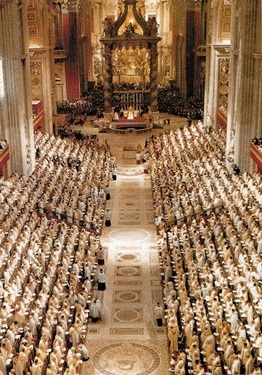 Ostensibly “Vatican II” was the reason for revising the concordat with Mussolini. The updated concordat invokes the “Declaration on Religious Freedom” issued by the Second Vatican Council in 1965. However, nothing there quarrels with the privileges given to the Church in the 1929 concordat. All it requires is that adherents of the other religions be allowed to worship freely.
If [...] special civil recognition is given to one religious community in the constitutional order of society, it is at the same time imperative that the right of all citizens and religious communities to religious freedom should be recognised and made effective in practice. [3]
As Fr. Brian W. Harrison, O.S., a professor in the Pontifical Catholic University of Puerto Rico, points out, this doesn't mean that other religious communities should have equal rights
in regard to public education, marriage legislation, chaplaincy to state institutions, civil religious ceremonies, the designation of public holidays (Our Lady's feast days, for instance), clerical immunity from civil prosecution, and other important aspects of civic life which reflect Catholicism's uniquely-recognized status. [4]
Thus the 1984 revisions of the Italian concordat appear to have been motivated less by any sudden inspiration from a document that was almost twenty years old than by the threat of losing the entirety of the favourable concordat with Mussolini which had come to be widely seen as “outdated”. [5]
Intese help shield the concordat from criticism
In Brazil the vocal opposition of many Protestant groups to the concordat there fell silent as soon as they were offered a few concordat privileges for themselves. [7] In Italy, by contrast, the Church took pre-emptive action to discourage questions about renewing Mussolini's concordat. Thus, already in 1984, at the same time as the revised concordat came through, the oldest Protestant group in Italy, the Waldensians, got a church-state agreement of its own called an intesa. Agreements were also made, one by one, with some of the other religious groups until now at least a dozen different denominations have intese, and negotiations for more of them are underway. [6] These intese are anchored in Article 8 of the 1947 Italian Constitution, but the political climate long delayed their implementation. [7]
An intesa grants clergy automatic access to state hospitals, prisons, and military barracks; allows for civil registry of religious marriages; facilitates special religious practices regarding funerals; and exempts students from school attendance on religious holidays. If a religious community so requests, an intesa may provide for state routing of funds, through a voluntary check-off on taxpayer returns, to that community. [8]
The Cardinal's “eight per thousand” scheme
 The 1984 concordat kept the Church receiving state funds (Article 7.6) until a “voluntary” system could be devised which, by default, would still give the lion's share to the Church. This is how it works.
All eligible churches compete with one another, and with a state fund “Beni Culturali” which supports museums and historical buildings), for 0.8% (otto per mille) of each taxpayer's taxes. Italian taxpayers may not refuse to pay this tax but non-religious persons may designate the State fund. If a taxpayer fails to make a designation, then .8 percent of his or her taxes are allocated on a pro rata basis based on the national average to eligible church bodies which have agreed to participate. [9]
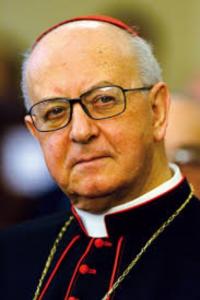
This clever arrangement was thought out by Bishop Attilio Nicora. The end effect putting it on a pro rata basis is that, although only 40 % of Italian taxpayers actually designate the Catholic Church as the recipient of their “church tax”, payments from almost 90% of them wind up in the Church coffers. [10] (And that's only what happens officially: for a look at what actually goes on, see “Church-tax scandal: Are secular Italians paying for Berlusconi's sins?”) And even those who direct their taxes to the state still wind up contributing to the upkeep of Church buildings as cultural artifacts. [11]
After a decent interval, Bishop Nicora was rewarded for his ingenuity with a cardinal's hat and became the Vatican's chief financial officer. As head of the Administration of the Patrimony of the Apostolic See (APSA) he managed the property of the Holy See (including numerous hotels) — and he also administered the huge state subsidies resulting from his own “church tax” negotiations. Then in 2011 this trusty Cardinal was appointed president of the Vatican's oversight body, Authority of Financial Information. [11] This puts him in charge of ensuring that Vatican transactions comply fully with European Union and international anti-money laundering and anti-terrorism financing laws, to try to prevent any more adverse publicity for the Vatican Bank. [12]
Revised concordat anchors Lateran tax exemptions
The tax breaks in the 1929 Lateran Treaty were retained (art. 30:h). Thus revised concordat continued to ensure that religious organisations would be tax-free, just like charities. It did however, permit the state to tax those activities carried on by the Church and its institutions which were non-religious, in other words, commercial. (art. 7.3)
 What was done with this provision illustrates how concordats work. They enforce minimum concessions to the Church, but have nothing to say when the state exceeds these. And in the face of a tight electoral race, giving the Church more than the concordat required struck an Italian politician as the shrewd thing to do.
At the end of 2005 Silvio Berlusconi, then the centre-right Prime Minister, extended the Church’s tax exemptions to include buildings used by the Church for businesses such as hostels or health clinics. Mr Berlusconi’s move was regarded by the Left as a blatant attempt to court the Catholic vote on the eve of the 2006 elections, which he narrowly lost to Romano Prodi and the centre Left.
The Prodi Government amended the tax breaks [in 2006], saying that only Church activities “which are not exclusively commercial” were exempt. However, the word “exclusively” left a loophole allowing properties with even a minor form of religious activity to benefit.
The Church owns 100,000 properties in Italy, 2,000 of them used as hospitals, clinics or rest homes. In Rome alone the Church owns 65 rest homes, 250 schools, 580 institutes, convents and monasteries and 18 hospitals. [13]
The state subsidies were so blatant that in June 2007 it was reported that the European Union's competition commissioner, Neelie Kroes, had opened an inquiry into the tax treatment of the church in Italy. The question was whether the tax concessions granted by the concordat amounted to illegal state aid to Church enterprises. Then in August a junior Italian finance minister, Paolo Cento, said the issue needed to be tackled in next year's budget. A few days later a senior Vatican official offered to renegotiate the concordat. [14] However, under pressure from both the Vatican and Italy, the EU investigation was dropped and there was no more talk of any willingness to renegotiate the concordat. Another attempt to investigate possible breaches of EU competiton law was announced in 2010.
Church blocks law on religious freedom, and thus subsidies to Muslims
Although the 1984 concordat states that the Catholic religion is no longer the sole religion of Italy, in 2007 the Church objected to the introduction of an omnibus religious freedom law which would “put the Catholic Church on the same level as religious sects” [15] and two years later it had still not been passed. [16]
Thus parliament must authorise the extension tax benefits to other denominations, which can let political pressure be brought to bear on the decision. This has worked to the disadvantage of Italian Muslims, for in the present political climate the Muslims are not able to obtain an intesa.
Unlike Britain and France, which are accustomed to the arrival of Muslims from their former colonies, Italian society has, until recently, been overwhelmingly Christian. Increasing the mistrust of Muslims is the fact that some of this migration is illegal, forcing some “clandestines” (clandestini) to turn to crime. [17] In 2006 the mounting political pressure against Islam in Italy was subtly supported by a provocative short story from a popular historical novelist, Valerio Manfredi, who favours Vatican social policies, [18] set his story, “The Last Christmas”, (“L’ultimo Natale”), in the future when the Muslim population in Italy had become larger than the dwindling numbers of Catholic faithful. It describes how on Christmas Eve the last Pope is forced to leave St. Peter's and the Vatican because he has to make way for an imam. [19] And, indeed, in 2010 the Vatican led official support to this scare story. The headline sums it up: “Have More Children and Go Back to Church or Europe Will Become Islamicized: Senior Vatican Official”. [20]
Little wonder then, that in August 2010 the Italian legislators voted to deny religious status to Islam, thus blocking income tax revenue for Muslim groups. Any further sharing of the tax funds, which flow overwhelmingly to the Catholic Church, needed the approval of a parliament which had a Christian Democratic majority. [21]
Notes
Sources for the last box on the right:
The Lampedusa solution: Italy hardens heart to refugees, Canberra Times, 7 February 2009. http://www.smes-europa.org/The%20Lampedusa%20solution.pdf
"Libya: End Live Fire Against Suspected Boat Migrants", Human Rights Watch, 16 September 2010. http://www.hrw.org/en/news/2010/09/16/libya-end-live-fire-against-suspected-boat-migrants
1. James T. Richardson, Regulating Religion: Case Studies from Around the Globe, (Springer, 2004), Google reprint, pp. 208.
2. Domenico Del Rio, "L' 'unité des catholiques italiens' ", Le Monde diplomatique, May 1988.
3. Article 6, “Declaration on religious freedom, Dignitatis humanae, on the right of the person and of communities to social and civil freedom in matters religious promulgated by His Holiness Pope Paul VI on December 7, 1965.” http://www.vatican.va/archive/hist_councils/ii_vatican_council/documents/vat-ii_decl_19651207_dignitatis-humanae_en.html
4. Brian W. Harrison. “The Center is holding”, a review of Michael Davies', The Second Vatican Council and Religious Liberty in Living Tradition: Organ of the Roman Theological Forum, (Oblates of Wisdom), Number 44, January 1993. http://www.rtforum.org/lt/lt44.html
5. Mauro Giovannelli, "The 1984 Covenant between the Republic of Italy and the Vatican: A Retrospective Analysis after Fifteen Years", Journal of Church and State, Vol. 42, 2000, p. 529.
6. International Religious Freedom Report 2000: Italy, [US] Bureau Of Democracy, Human Rights, and Labor. http://atheism.about.com/library/irf/irf00/blirf_italy00.htm
7. "Brazilian groups oppose the concordat: texts", Concordat Watch. http://www.concordatwatch.eu/topic-40671.843
7. Massimo Introvigne, " 'Praise God and Pay the Tax': Italian Religious Economy - An Assessment", A lecture at the Institute of World Religions, Chinese Academy of Social Sciences, Beijing (China), 12 March 2002. http://www.cesnur.org/2002/mi_italianrel.htm
8. International Religious Freedom Report 2009: Italy, [US] Bureau Of Democracy, Human Rights, and Labor, 26 October 2009. http://www.state.gov/g/drl/rls/irf/2009/127317.htm
9. James T. Richardson, Regulating Religion: Case Studies from Around the Globe, (Springer, 2004), Google reprint, pp. 208.
10. Luisa Brandl, Die blühenden Finanzen des Vatikans, Stern, 6 September 2007. http://www.stern.de/wirtschaft/finanzen-versicherung/597047.html
11. "Vatican: Holy See seeks to boost financial watchdog's independence", Adnkronos, 7 July 2011. http://www.adnkronos.com/IGN/Aki/English/Religion/?id=3.1.2215431271
12. Vatican Bank (Institute for Religious Works), Concordat Watch.
13. Richard Owen, "Vatican faces EU inquisition on tax", The Times, 31 August 2007. http://www.timesonline.co.uk/tol/news/world/europe/article2357980.ece
14. John Hooper, "Church ready to forgo tax breaks", The Guardian, 28 August 2007. http://www.guardian.co.uk/world/2007/aug/28/italy.johnhooper
15. "Italian bishops concerned by terms of religious freedom law", Catholic World News, 8 July 2007.
16. Freedom House, “Freedom in the World 2009 - Italy”, 16 July 2009. http://www.unhcr.org/refworld/docid/4a6452ac23.html
17. “New Trends in Italian Immigration Policies”, Real Insituto Elcano, 9 December 2008, footnote 3. http://www.realinstitutoelcano.org/wps/portal/rielcano_eng/Content?WCM_GLOBAL_CONTEXT=/elcano/Elcano_in/Zonas_in/ARI161-2008
18. Manfredi is a frequent contributor to conferences of the Compagnia delle Opere, a powerful business and cultural group which advocates the privatisation of state enterprises and the promotion of Catholic social policies. It was founded in 1986 by Monsignor Luigi Giussani.
19. Book reviews in Italian of “L’ultimo Natale”:
http://www.ciao.it/Zeus_e_altri_racconti_V_M_Manfredi__693238
http://www.7doc.it/italiano/16990-l-ultimo-natale---valerio-massimo-manfredi.html
20. “Have More Children and Go Back to Church or Europe Will Become Islamicized: Senior Vatican Official”, Life Site News, 22 September 2010. http://www.lifesitenews.com/ldn/2010/sep/10092206.html
21. “Italy: Islam denied income tax revenue”, Adnkronos, 27 August 2010. http://www.adnkronos.com/AKI/English/Religion/?id=3.1.880028077

