



 “Margin of appreciation” permits crucifixes in Italian state schools (2011), a niqab ban in France (2014) and a general erosion of human rights.
The European Court of Human Rights (ECHR) has loosened the application of human rights by taking into account the customs of the country, a principle called the “margin of appreciation”. Under heavy pressure it allowed Italy to uphold its Catholic traditions in public schools and four years later permitted France to maintain its secular tradition in public spaces. A former ECHR judge comments on what he calls the Court's increasing "timidity".
2010: Italy is allowed to maintain its religious tradition
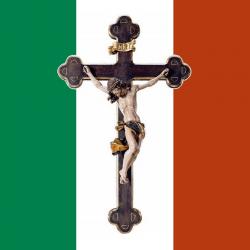
The ECHR ruled that the display of crucifixes in Italian state schools did not violate the rights of non-Christian students. This overturned an earlier judgement known as Lautsi versus Italy. The final ruling loosened the application of human rights by saying that the classroom crucifixes came within the “margin of appreciation” given to individual countries, in accordance with their customs.
Ms Lautsi’s children attended a state school in Italy where each classroom had a crucifix on the wall. The Lautsis wished to bring up their children without religion and asked for the crucifixes to be removed from the school, which was public property. The school refused to do so. This led to a series of three conflicting legal decisions:
- First, the Italian Administrative Court refused Ms Lautsi’s complaint against the school, arguing that the crucifix was a cultural, not a religious symbol. (2005)
- Next, the European Court of Human Rights (ECHR) upheld her complaint against the crucifix in the name of the right to education and freedom of thought. (2009)
- Finally, the Grand Chamber of the ECHR reversed this judgement, citing the “margin of appreciation” permitted to individual countries. (2011)
1. The cross judged to be a symbol of Italy (2005)
In 2005, when the Italian Administrative Court refused turned away the parent who objected ot the classroom cross, it argued that the crucifix was an expression of Italian cultural heritage. This argument found resonance. It has been said that in Italy supporting “Christian heritage” has become a code word for opposing (Muslim) immigration. And, indeed, until the expansion of the EU in 2004 North Africa was the source of the largest group of immigrants to Italy. [1] The Church appears to have sought to make this connection, perhaps as part of a larger strategy of keeping Turkey out of the European Union.
In September 2000, Bologna Cardinal Giacomo Biffi issued a pastoral letter, in which he called for an immigration policy favoring Catholics over those who are Muslim “in order to safeguard our nation's identity.” Biffi’s letter provoked protests but also drew support. One prominent priest, Gianni Bagget Bozzo, ... affirmed “the need to erect a Christian dike against the Muslim invasion of Italy.” [2]
Pope Benedict XVI openly supported the appeal by the Italian Government against removing crucifixes from state schools, saying that it acted “in conformity with a correct view of laicism”. [3]
2. The European Court of Human Rights (ECHR) says the crucifix must go (2009)
Following the refusal of the Italian court to accept her application, Ms Lautsi complained before the European Court of Human Rights that the display of the crucifix in the State school attended by her children was in breach of two articles of the European Convention on Human Rights. These were Article 9 (freedom of thought, conscience and religion) and of Article 2 of Protocol No. 1 (right to education in accordance with the parents’ beliefs). In its judgement of 2009 the ECHR largely supported her.
3. The judgement is reversed: the crucifix can stay in the classroom (2011)
With the aim of getting this unanimous ECHR judgement reversed, Italy launched an appeal and an international campaign was begun to back this up. This brought results. In 2011 the Grand Chamber of the ECHR overturned the crucifix ban. The Court found no violation of Ms Lautsi’s right to educate her children according to her own beliefs, since they were not being indoctrinated by merely being exposed to a crucifix on the classroom wall. From this it followed that the right to freedom of belief had not been violated. Furthermore, when it came to displaying religious symbols, there was great diversity within the European Union and, so long as human rights were not being infringed by any of this, it was not the Court’s job to enforce uniformity. Each country has a “margin of appreciation”.
What caused this reversal the Court’s crucifix ban two years earlier? The obvious difference in the two sets of proceedings is the massive intervention of third parties before the final appeal. They confronted the court with widespread outrage throughout Europe and managed to convince the court that crucifixes in the classroom were permissible because they fell within the “margin of appreciation”. [4]
“Margin of appreciation” gives the judges wiggle room
At first the legal; concept of a “margin of appreciation” was called “discretion” and this is a useful way to think of it. [5] A judge applies the law with discretion, tailoring it to individual circumstances, but keeping within the range of possible solutions allowed by the law. Likewise, a justice of the ECHR applies the European Convention of Human Rights with a margin of appreciation, tailoring it to the individual nations, but keeping within the range of possible solutions allowed by the Convention. In this respect, as the interveners pointed out, the job of the ECHR judges is more complicated that that of a country’s constitutional (or supreme) court where they only have to deal with the circumstances of one nation. [6]
The “margin of appreciation” appears in the very first judgement handed down by European Court of Human Rights in 1961. There the Court said that a state, (Ireland), had a margin of appreciation “in determining whether or not there is a public emergency threatening the life of the nation.” [7] However, after being introduced to give states some discretion in judging their own national security needs, margin of appreciation is now increasingly invoked in connection with religious beliefs.
This was the case fifty years later when the Court was called to rule on crucifixes in state schools. There the Court was faced with widely differing practices between countries like Italy, Poland and Malta where crucifixes in public buildings are customary and those like France where this would be illegal. A further complication is that in many countries these differing views are themselves changing, back and forth. Little wonder, then that “the European Court, when facing such delicate issues, prefers not to rule, particularly where a common European standard does not exist.” [8] The assumption behind this abdication is that the countries themselves are the best ones to judge local circumstances. [9] Thus margin of appreciation offers a way to implement the Catholic social principle of subsidiarity. [10]
 Massive third-party interventions and secret financial threats to the European Court of Human Rights
The involvement of third parties marks a departure from the strictly adversarial nature of the justice system where testimony was made on behalf of either the complainants or the defendants. The traditional practice is designed to air both sides. However, sometimes a problem has more than two sides. This is especially likely when courts such as the ECHR are called upon to decide legal questions of major public importance, with implications going far beyond the facts of the case at hand. Here third parties may be able to highlight aspects not raised by the two adversaries. [11] This is why the right for third parties to intervene, as article 36, is written into the European Convention on Human Rights.
Ten states chose to use this provision to appeal against the crucifix ban as third parties: Armenia, Bulgaria, Cyprus, Greece, Lithuania, Malta, Monaco, Romania, the Russian Federation and San Marino. Counting Italy, as well, this showed the Court that 11 out of the 47 Member States of the Council of Europe were publically opposed to the banning of crucifixes in the classrooms of state schools.
This broad intervention is something new. According to the director of the European Centre for Law and Justice, Gregor Puppinck, it is “an important precedent in the practice of the court, because usually member States abstain from intervening, or intervene only when the case affects a national of their State.” [12] And the religious ties of these third-party nations is also a sign of things to come. The close cooperation of countries which are predominantly Catholic and Eastern Orthodox, is a fruit of what the Moscow Patriarch calls a “strategic alliance between Catholics and Orthodox”. [13]
Given the Court's dependence on the voluntary cooperation of the Member States, the opposition to its verdict may have given the justices reason for pause. The ruling was handed down on 3 November 2009 and the reaction was swift, with Bavaria firing a salvo the very next day. Among the EU countries only Spain was depicted in the news as supportive of the ECHR ruling against the crucifix, while Austria wondered how to reconcile the ban on crucifixes in the classroom with the concordat guarantee for them, and Poland and Slovakia joined Bavaria in opposing it.
♦ Spain: On 2 December 2009 a Spanish parliamentary commission approved by 20 votes to 16 a motion calling on Madrid to implement November’s ruling by the Strasbourg court. Many in Spain say the rapidity with which by the Spanish government acted on the issue and its willingness to implement the ECHR’s ruling even before the final outcome of the Italian appeal is known, is a not so subtle warning to the Vatican to stay out of Spanish politics. [14]
♦ Austria: It was widely noted that the 1962 “School concordat” guaranteed crucifixes in any class where most of the students were Christian and that this could not be changed without the agreement of the Vatican. [15]
♦ Bavaria (Germany): On 4 November 2009 representatives of both of the governing coalition parties, CDU and FDP, confirmed that crucifixes will remain in the classrooms of state schools unless a parent objects. [16] How this can work in practice is shown in the case of a parent who had complained for many years with no result ― until she finally sued the school for doing nothing. [17]
The Bavarian dissent from the ECHR ruling reflected German legal norms. In 1995, after large demonstrations led by both Protestant and Catholic bishops in favour of retaining crosses in state schools, the German Federal Constitutional Court struck down the order to ban them. Even before the Highest German court stepped in to allow crucifixes, Bavaria refused to comply with the ban. First the Bavarian Premier said he’d ignore the ruling and then his government passed a law to sidestep it and retain crosses in the classrooms of primary state schools. The Bavarian law invokes the “will of the majority” . [18]♦ Poland: On Poland’s National Day, 11 November 2009, President Lech Kaczyński said “No one in Poland thinks crucifixes shouldn’t be hung in schools. No way. Maybe somewhere else. But not in Poland”. [19] Then on 3 December a resolution (which was not legally binding) passed Poland's lower house of parliament which “expressed worry over decisions which infringe upon freedom of religion, disregard laws and the feelings of believers and upset social calm.” [20]
♦ Slovakia: On 10 December 2009 the Slovak Parliament issued a declaration that the placing of religious symbols in schools and public institutions is in line with the historical traditions of Slovakia. It openly challenged the ruling of the ECHR: “Respecting this tradition cannot be perceived as a restriction on the freedom of religion”. [21]
In other words, within weeks of issuing its 2009 ruling, the ECHR found itself with a Europe-wide rebellion on its hands. Under these circumstances it is easy to see how it could become necessary for the ECHR to use margin of appreciation in order to help maintain the Court’s authority. For, unlike a national court whose judgements can be enforced by the police, the ECHR depends upon voluntary compliance of the member states of the EU. The numerous and emphatic third-party interventions will have reinforced this point with the ECHR justices. It was clear that the final ruling of its Grand Chamber would have to reflect this.
The Council of Europe, which oversees the European Court of Human Rights points out that
...the process of realising a “uniform standard” of human rights, protection must be gradual because the entire legal framework rests on the fragile foundations of the consent of the Member States. The margin of appreciation gives the flexibility needed to avoid damaging confrontations between the Court and the Member States [...] [22]
This hopeful interpretation of margin of appreciation implies that it is merely a stopgap until such time as the various European states achieved the same level of respect for human rights. But, of course, theocratic interests do not want use of the margin of appreciation to gradually lose its relevance, for it is a useful legal weapon to weaken human rights in Europe. This is why it is ominous that margin of appreciation and its sister concept of subsidiarity have been quietly inserted into the preamble of the European Convention of Human Rights. In that position they are invoked before the very rights that they can be used to mitigate. [23]
As one legal expert warns, “there is a serious question whether the application of the doctrine is consistent with the idea that human rights treat individuals as central, giving them "rights" as against the principal subjects of international law, the states.” [24] In other words, margin of appreciation has the potential to undermine the human rights of individuals by upholding the rights of groups.
Still more ominous was the financial pressure apparently put on the ECHR, as reported by a reliable source who does not wish to be named
After querying the extraordinary and unprecedented reversal of a unanimous decision of the lower court, I was told that Italian diplomats had visited senior officials in a member state, encouraging them to put pressure on the European Court to reverse the decision by threatening to withdraw funds if they failed to do so. This was apparently part of a tour of states by the diplomats and presumably failure to co-operate would have been regarded as damaging bilateral relations with Italy. In retrospect how else could such an extraordinary reversal have been achieved?
2014: France is allowed to maintain its secular tradition
 In 2011 France banned the wearing of clothing in public places that concealed the face. The intention was to outlaw the niqab (a veil that leaves only the eyes visible) and the burka (a loose garment covering the entire body with a mesh screen over the face). A French Muslim woman challenged this before the ECHR and in 2014 the Court supported the French ban. [25]
The Court accepted that
the barrier raised against others by a veil concealing the face is perceived by [France] as breaching the right of others to live in a space of socialisation which makes living together easier. (para. 122)
The Court did note "the flexibility of the notion of' 'living together' and the resulting risk of abuse", yet it still justified this argument. One legal expert called this conclusion
disappointing, particularly the reliance on the nebulous concept of ‘living together’, an aim which could equally be met by promoting a ‘live and let live’ attitude, and which moreover could lead to bans on anything that makes the majority feel uncomfortable. [26]
She speculated that the Court's "timid approach" may be partly explained by the rise in Euroscepticism. Be that as it may, this judegment could be seen as further eroding the primacy of human rights.
ECHR survival at the cost of watering down human rights judgements?
A former Icelandic judge at the ECHR, David Thor Björgvinsson, has noted how judicial attitudes have shifted since he came to the Strasbourg Court in 2004. In 2015 he said that "the Court is changing its judicial policy from assertively protecting human rights to becoming more timid". [27] He attributes this to judicial fears about the survival of the Court which, unlike national courts, has no enforcement mechanisms. Furthermore, a country can simply choose to withdraw from the European Convention of Human Rights, and therefore from the Court's jurisdiction — as indeed the UK has threatened to do. [28]
The judge sees the Court's increasing its reliance on the margin of appreciation and referring more to the democratic process in the Member States, as an attempt to appease its most prolific critics. This is precisely the reason for the massive third-party interventions, as in the Italian crucifix case. The initial ruling against the display of crucifixes in Italian state schools caused the most widespread opposition in the history of the European Court of Human Rights, with 20 countries officially joining Italy "in defense of the crucifix". [29]
Putting the judges on the defensive is proving to be an effective way of eroding their ability to uphold human rights.
Documents
Italy:
Summary released by the European Court of Human Rights (18 March 2011):
Crucifixes in Italian State-school classrooms: the Court finds no violation (This contains extensive quotes from the 2005 judgement of the Italian Administrative Court.)
Full ruling by the Grand Chamber (18 March 2011):
Case of Lautsi and others v. Italy
Oral intervention by Joseph H.H. Weiler on behalf of several third-party intervening states (30 June 2010)
Official summary of the 2009 ruling in English:
Crucifix in classrooms: Contrary to parents’ right to educate their children in line with their convictions and to children’s right to freedom of religion.
Full ECHR ruling (3 November 2009) of “Lautsi versus Italy” in French and English translation
France:
European Court of Human Rights, "S.A.S. v France" - 43835/11 - Grand Chamber Judgment [2014] ECHR 695 (01 July 2014) http://www.bailii.org/eu/cases/ECHR/2014/695.html
Further reading
Paolo Ronchi, “Crucifixes, margin of appreciation and consensus: the Grand Chamber ruling in Lautsi v Italy”, Ecclesiastical Law Journal, 01 September 2011, vol. 13 : pp 287-297. http://journals.cambridge.org/action/displayAbstract?fromPage=online&aid=8351821
The European Parliament Platform for Secularism in Politics, “Lautsi v Italy”. http://politicsreligion.eu/news/lautsi-v-italy/
Neil Addison (Barrister), “Italian Crucifix Case - Grand Chamber Judgment, Religion Law Blog”, 21 March 2011. http://religionlaw.blogspot.com/search?updated-max=2011-04-11T19%3A48%3A00%2B01%3A00&max-results=7
Americans United for Separation of Church and State, “European High Court Approves Crucifixes In Public Schools”, Church & State, May 2011. http://findarticles.com/p/articles/mi_qa3944/is_201105/ai_n57627297/
Notes
The quote in the box with cross and crescent is from http://echrblog.blogspot.com/2010/02/italy-asks-for-referral-to-grand.html
1. “Demographics of Italy”, Wikipedia. http://en.wikipedia.org/wiki/Demographics_of_Italy
2. “International Religious Freedom Report: Italy”, [US] Bureau of Democracy, Human Rights, and Labor, 2001. http://www.state.gov/g/drl/rls/irf/2001/5698.htm
3. “Religion Plays Key Role in Public Square, Says Pope”, Zenit, 17 December 2010. http://www.zenit.org/article-31271?l=english
4. Grand Chamber, ECHR, Case of Lautsi and others v. Italy, 18 March 2011, §70.
5. Onder Bakircioglu, “The Application of the Margin of Appreciation Doctrine in Freedom of Expression and Public Morality Cases”, German Law Journal, 2007, vol. 8, no 7, p. 711. http://www.germanlawjournal.org/pdfs/Vol08No07/PDF_Vol_08_No_07_711-734_Articles_Bakircioglu.pdf
6. Grand Chamber, ECHR, Case of Lautsi and others v. Italy, 18 March 2011, §56.
7. Quoted in Bakircioglu, p. 714.
8. Bakircioglu, p. 716.
9. Bakircioglu, p. 723.
10. Bakircioglu, p. 717.
11. To assist the Court: Third party interventions in the UK, Justice, 26 October 2009, p. 4. http://www.justice.org.uk/resources.php/32/to-assist-the-court
12. “ECHR Crucifix Case: Ten Member States Join Italy in Support of the Crucifix”, European Centre for Law and Justice, 1 June 2010. http://www.eclj.org/Releases/Read.aspx?GUID=a77d9063-0475-408f-84a6-8a608be0077e&s=eur
13. Metropolitan Hilarion, chairman of the Department of External Affairs of the Moscow Patriarchate quoted in “Why 20 Nations Are Defending the Crucifix”, Zenit, 21 July 2010. http://www.zenit.org/article-29956?l=english See also “Ecumenical allies? Orthodox, Catholics take aim at European secularism”, Catholic News Service, 11 December 2009. http://www.catholicnews.com/data/stories/cns/0905462.htm
This marked the second recent intervention by the European Centre for Law and Justice (ECLJ) in aid of a Vatican campaign. (The first was in the 2010 Irish abortion case.)
14. “Spain Moves To Ban Crucifixes In Schools”, Lez Get Real, 2 December 2009. http://lezgetreal.com/?p=23537
15. Vertrag vom 9. Juli 1962, BGBl. Nr. 273, zwischen dem Heiligen Stuhl und der Republik Österreich zur Regelung von mit dem Schulwesen zusammenhängenden Fragen, Schlussprotokoll, Zu Artikel I, § 2, Absatz 1. http://www.uibk.ac.at/praktheol/kirchenrecht/ru-recht/gesetze/vertragsrecht/schulvertrag.html
Before the 1962 education concordat it had been left up to each Austirian school to decide whether or not to hang a crucifix in the classrooms.
More precise regulation is effected by the Religious Instruction Law (Religionsunterrichtsgesetz), § 2b, which prescribes a crucifix on the wall of every classroom where there is a Christian majority, (which in Austria means almost everywhere). http://www.ris.bka.gv.at/GeltendeFassung.wxe?Abfrage=Bundesnormen&Gesetzesnummer=10009217
16. “Kruzifixe in Bayerns Schulen sollen bleiben”, Augsburger Allgemeine, 4 November 2009. http://www.augsburger-allgemeine.de/Home/Nachrichten/Bayern/Artikel,-Mutter-kaempft-jahrelang-gegen-Kreuz-in-Nuernberger-Grundschule-_arid,2048755_regid,2_puid,2_pageid,4289.html
17. “Jahrelanger Kampf gegen Kreuz im Klassenzimmer”, Augsburger Allgemeine, 19 January 2010. http://www.augsburger-allgemeine.de/Home/Nachrichten/Bayern/Artikel,-Mutter-kaempft-jahrelang-gegen-Kreuz-in-Nuernberger-Grundschule-_arid,2048755_regid,2_puid,2_pageid,4289.html
18. Susanna Mancini, “The Power of symbols and symbols as power: secularism and religion as guarantors of cultural convergence”, Cardozola Review, 7 July 2009, p. 2636. http://www.cardozolawreview.com/content/30-6/MANCINI.30-6.pdf
19. “Prezydent: Polacy nigdy nie zrezygnowali” (“President: The Poles never gave up”), Gazeta Wiadomosci, 11 November 2009. http://wiadomosci.gazeta.pl/Wiadomosci/1,80708,7243287,Prezydent__Polacy_nigdy_nie_zrezygnowali.html
20. “Poland ‘worried’ by Court school crucifix ban”, Javno, 3 December 2009.
http://www.javno.com/en-world/poland-worried-by-court-school-crucifix-ban_284698
21. “Slovak parliament objects to European court ruling on religious symbols”, Slovak Spectator, 11 December 2009.
22. “The margin of appreciation”, Council of Europe, 2008. http://www.coe.int/t/dghl/cooperation/lisbonnetwork/themis/echr/paper2_en.asp
23. “Green light for Draft Protocol 15 to the European Convention on Human Rights by the Legal Affairs Committee”, Parliamentary Assembly Council of Europe (PACE), 20 March 2013.
http://assembly.coe.int/ASP/NewsManager/EMB_NewsManagerView.asp?ID=8517&L=2
24. Yutaka Arai-Takahashi, The Margin of Appreciation Doctrine and the Principle of proportionality in the Jurisprudence of the ECHR, 2001, p. 227.
25. For a good analysis of the judgement, see: Matthew Flinn, "The paradox beneath Strasbourg’s French veil ban decision", UK Human Rights Blog, 16 July 2014. http://ukhumanrightsblog.com/2014/07/16/the-paradox-beneath-strasbourgs-french-veil-ban-decision/
26. Lucy Vickers, "Conform or be confined: S.A.S. v France", OxHRH Blog, 8 July 2014. http://ohrh.law.ox.ac.uk/conform-or-be-confined-s-a-s-v-france/
27. David Hart QC, "ECtHR judge ponders on EU/ECtHR dogfight, and recent trends of timidity in the ECtHR", UK Human Rights Blog, 6 October 2015.
http://ukhumanrightsblog.com/2015/10/06/ecthr-judge-ponders-on-euecthr-dogfight-and-recent-trends-of-timidity-in-the-ecthr/
28. "Cameron 'committed to breaking link with European court of human rights'", Guardian, 1 June 2015. http://www.theguardian.com/law/2015/jun/01/david-cameron-european-court-of-human-rights
29. "Why 20 Nations Are Defending the Crucifix", Zenit, 21 July 2010. http://www.zenit.org/en/articles/why-20-nations-are-defending-the-crucifix

