



 “Europe’s last dictator” seeks Vatican acceptance
Even the brutal tactics by President Lukashenko of Belarus in the December 2010 elections did not disturb his concordat negotiations with the Vatican — only the presumed objections of the Russian Orthodox Church, which now supports Putin's war machine. Lukashenko's reign of terror ensures that when a concordat finally comes, it will be ratified, but he will wish to avoid antagonising the Belarusian Orthodox Church that is part of the Russian one. No longer shunned by Western nations, he has less need of Vatican recognition. It is acknowledged by both sides that the concordat talks have "stalled".
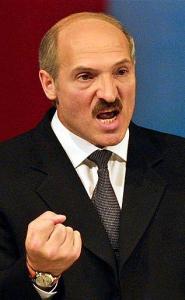 At the end of 2010 President Aleksandr Lukashenko of Belarus did it again. He terrorised his way to another election “victory”, making full use of the security service, (still called the KGB), [1] Long known as “Europe’s last dictator”, his performance in these elections earned him a new epithet: “Europe’s Mugabe”. [2] But there was no word of censure from either the Vatican or the Orthodox Church. In fact, Patriarch Kirill, the primate of the Russian Orthodox Church, to which the Belarusian one belongs, warmly congratulated him on his re-election. [3]
The Belarusian Orthodox Church (BOC), which is the state church of Belarus, is a branch (exarchate) of the Russian one and it takes its lead from Patriarch Kirill, the primate of the Russian Orthodox Church. He, in turn, supports the Russian President Putin. This situation requires Lukashenko to keep gauging how much independence he can afford to display.
As the scholar Valiancin Akudovich has stated: "The Russian Orthodox Church is Moscow's 'fifth column' in Belarus. … [Lukashenka] is constantly balancing his relations with the Russian Orthodox Church. If it displays too much initiative and independence, he 'disciplines' it, and when necessary, he earns political capital on it – both inside the country and in foreign relations.” [4]
The Vatican will understand this and was obviously hoping to get the concordat through quickly while Lukashenko felt himself in a position was to brave Orthodox displeasure to do this.
A Vatican fix for the declining population?
With the election safely behind him Lukashenko was free to concentrate on trying to force Belarusian women to help him meet his demographic goals.The population of Belarus had declined by half a million in ten years. [5] Belarusians have been reluctant to have children due to poverty and fear of birth defects. [6] Although Chernobyl is located in the Ukraine, it’s only four miles from the Belarusian border and in the days after the 1986 explosion of the nuclear reactor there, the southeast wind and spring rains deposited most of the radioactive contamination in Belarus. In 1994, the year Lukashenko became president, Belarusian newspapers were running almost daily ads from parents pleading for donations to pay for the otherwise unaffordable leukemia treatment for their dying children. [7]
On paper Belarus had a very liberal policy, as its abortion law still dated from Communist times when contraceptives were scarce and abortion was widely used as a method of birth control. However, though the law hadn’t changed since then, the reality was that most Belarusian women seeking abortions were turned away by the state-owned hospitals. A directive from the Ministry of Health required all women of fertile age to be put on a special database called the “National reproductive reserves” which denied them access to abortion in free, state-owned clinics. [8]
A useful ally in Lukashenko’s attempts to boost fertility is the Vatican. The Catholics make up about 12 percent of the population in Belarus. In 2010 they began to mount an energetic grassroots campaign to boost the birth rate. Warnings were given on the harmfulness of contraception and abortion, and daily prayer vigils were held outside the Vitebsk abortion clinic. [9] This complements the population-boosting programme recently put forward by the Belarusian Orthodox Church (BOC). Its Russian mother church has said it wishes to eliminate abortion, by which it also means the morning-after pill for emergency contraception. [10] It has successfully urged the government in Moscow to put forward a number of measures to make abortion more time consuming, expensive and guilt-laden. [11] This strategy is often used where an outright ban is not yet politically feasible and it has already made abortion practically unobtainable in some parts of the US. [12])
Right after the 2010 election the Belarusian Government began its own population drive. It announced that in the first two months of 2011 there was an “excess of deaths over births by 6347”. [13] No mention of another population measure, that of life expectancy. This would reveal the “female advantage”, the margin by which women outlive men. In 2000 the differential was 4.5 years worldwide ― and the highest in the world, 12.3 years, was found in Belarus. [14] This is an indication of the alcoholism rampant among Belarusian men.
Alcohol has been a traditional tool of Russian autocrats: Catherine the Great said it is easier to rule a drunk public and under Stalin cheap vodka be sold by the glass at “at every street corner”. [15] Lukashenko, too, appears to appreciate the political passitiy of alcoholics. He prefers to crack down on legal abortions, which will likely result in the deaths of many more Belarusian women ― rather than on the alcoholism which kills off so many Belarusian men.
Vatican recogniton, at a price
Like leaders in other former Soviet republics, Lukashenko has tried to play off Russia and the West against one another. His problem, however, is that the European Union insists on human rights. His solution was to deal with the one European state that would still tolerate his behaviour and could even help him force the unhappy women to reproduce — the Vatican.
In 2008 Lukashenko was “desperate to boost his reputation ahead of September’s parliamentary elections — including hiring a British public relations firm in March to package his policies in for Western consumption”. [16] Another public relations coup would be recognition by the Pope, and in June 2008 Lukashenko hosted the Vatican Secretary of State, Cardinal Bertone. As Yaroslav Romanchuk, head of the Mises Research Centre in Minsk, observed:
The cardinal could be a sort of intermediary between Europe and Belarus. And an influential intermediary, at that. This is a way for [the Belarusian] authorities to act in Europe through the Vatican. If Lukashenko can show that Belarus respects religious rights, that would be a step towards breaking out of isolation. [17]
(Protecting “religious rights”, of course, is the ostensible purpose of concordats with the Vatican.) The Cardinal reinforced this idea, saying that the Roman Catholic Church recognised Belarus’ mission as a bridge between the East and the West and was ready to help smooth its international relations. [18]
At the June meeting in Minsk the President indicated approval of an “agreement” between Belarus and the Holy See that would also give the Catholic Church the legal right to work with government institutions. This is already done by the Belarusian Orthodox Church which has 14 agreements with various state bodies. [19] Cardinal Bertone even took the occasion to condemn as “strongly unacceptable” European sanctions against Belarus imposed in response to political suppression and human rights abuses. [20] This is surprising, because the restrictions put in place by the EU were principally travel bans against top officials of this brutal government, penalties which have been constantly adjusted in order to try to nudge Belarus towards more democracy. [21]
Talks with the Vatican paused to cheer the Russian tanks
At the cordial meeting in Minsk there was also talk of a papal visit, but in August the Kremlin effectively pre-empted the pope. Russia invaded Georgia and publicly chastised Belarus for not voicing support. Belarus quickly changed course and dutifully cheered the Russian tanks. [22]
This ended official Belarusian dealings with the Vatican for a while. Prudence dictated a public show of exclusive support for the Belarusian Orthodox Church. Despite the fact that in 2009 only about 48% of Belarusians claim to be Orthodox, Belarus has concluded church-state pacts with the BOC which give the church many concordat privileges. These Orthodox “concordats” are signed by Filaret, the Metropolitan of Minsk and Slutsk, Patriarchal Exarch of all Belarus.
By contrast, the Catholic Church in Belarus has been cautious in recent decades.
It is aware that Moscow is sensitive about Catholic activities in areas that the Russian Orthodox Church considers its own. And yet, the Catholic Church has quietly expanded its influence, establishing parishes in some eastern regions of Belarus that had never witnessed a Catholic presence. [23]
This nation-wide extension is an important step towards changing the traditional view in Belarus that the Catholic Church was foreign. Formerly it was concentrated in the western part of the country, adjoining Poland, with priests whe were mostly Polish in origin. [24]
It was Russia itself that inadvertently provided Lukashenko with the means to try to improve relations with the Vatican. In 2008, after Russia invaded Georgia, the European Union lifted Lukashenko’s travel ban to the EU which had been imposed in 1999 over suppression of the opposition and human rights abuses. [25] Officials in Brussels had feared that Russia might attempt to bring other neighbours under its sway, and so they let Lukashenko in. He then went straight to Italy and the first person he met was the Pope. [26] According to a Russian commentator
this meeting definitely gives Aleksandr Lukashenko certain advantages. The trivial knocks he got from some Czech officials, who promised not to shake hands with him and not to let him out of the plane, have lost their edge after the Belarusian president has improved his image in the Pope’s parlour. [27]
Lukashenko used his 27 April 2009 visit to the Vatican to discuss the “details” of the forthcoming concordat with Cardinal Bertone. [28] He also met with the Prince-Cardinal who heads the Sovereign Military Order of Malta (SMOM), but the purpose of this was glossed over as, “new forms and areas of interaction”. [29] The Order of Malta is a worldwide Catholic religious order which claims quasi-statehood and on this basis makes concordat-like “international treaties” to facilitate Vatican-approved health care. [30]
The next year, at the end of 2010, it was announced that a draft concordat was ready for signing. [31] This was at a time when, reacting angrily to criticism of his election thuggery, Lukashenko vowed to do away with what he described as “mindless democracy.” [32] The rest of Europe reacted with dismay — but not the Vatican, Europe’s last absolute monarchy.
A concordat washes whiter
In an authoritarian society official recognition acts as a powerful signal. When the Communist regime ended, many atheist apparatchiks adopted the new religious party line and became Orthodox, as they say in Belarus, “in a click”. Thus the state recognition of Catholicism afforded by the concordat can only help the growth of the Catholic Church in Belarus.
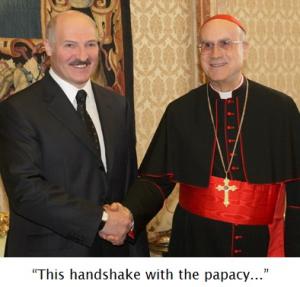 Official recognition means something else, as well. Once again the Vatican appears to be offering respectability to a leader who is internationally shunned — at the price of a concordat. This it did for Hitler some 80 years before. After the concordat between the Nazi regime and the Holy See had been concluded in the summer of 1933, Cardinal Faulhaber (who ordained the present pope), sent a handwritten note to Hitler:
For Germany’s prestige in East and West . . . this handshake with the papacy, the greatest moral power in the history of the world, is a feat of immeasurable blessing. [33]
And in a 1937 sermon the Cardinal confirmed that the conclusion of a concordat with Hitler’s regime had indeed had the international impact he’d earlier predicted:
At a time when the heads of the major nations in the world faced the new Germany with cool reserve and considerable suspicion, the Catholic Church, the greatest moral power on earth, through the Concordat expressed its confidence in the new German government. [34]
After the announcement on 6 December 2010 that the draft concordat was now prepared and waiting, there was a new development which, however, did nothing to threaten this cordial relationship. This was the brutal suppression of peaceful demonstrations against the 19 December re-election of Lukashenko, widely regarded as fraudulent. (See the appendix at the end.)
Vatican ignored prisoners then, under pressure, blamed “technical reasons”
Monitors from the OSCE, Europe’s main election and human rights watchdog, said the vote count was “flawed” and “bad or very bad in almost half of all observed polling stations”. [35] They were then ordered to leave the country. [36] However the Belarusians who were thrown into gaol don't have this option. They asked the papal nuncio to forward a letter to Pope Benedict: “Today Belarus is enshrouded in darkness. Arrests of activists, raids and pogroms at independent websites and newspaper offices, searches of apartments continue. The authorities are blackmailing the political prisoners using their little children. We are seeking your help.”
In vain. Their appeal, released on 4 January 2011 by the Belarusian human rights group Charter 97 and reproduced below, was ignored. At first the papal nuncio, who was negotiating the concordat, refused to even meet with the relatives of the prisoners. [37] Finally, on 11 January, after Charter 97 had spread news of his refusal worldwide, he agreed to a meeting, blaming “technical reasons” for not having done so before. [38]
There has been no papal condemnation of the assaults and imprisonment, in stark contrast to the Pope's call on 10 Janaury for Middle Eastern governments to do more to protect their Christian minorities. [39] The reason for this appears to be strategic. To bolster its claims to Christian sites in the Holy Land, the Vatican needs to stem the exodus of Christians. The Pope was willing to risk a diplomatic stir by chastising Arab governments for not preventing assaults on some of their citizens. [40] However, in Belarus, where the government was actually committing assaults on its people, the Pope remained silent. He wanted their persecutor to give him a concordat.
Another Russian invasion stalls the concordat again
The concordat, was originally expected to be signed soon after the text was finished at the end of 2010, but nothing happened. According to "sources in the Catholic hierarchy" the Russian Orthodox Church and Russia's ambassador in Belarus, made every effort to prevent the signing. Belarusian authorities then "suggested substituting it with specific-area agreements concluded with the local Catholic authorities, thus downgrading the legal framework of relations." [41] However, in situations like this the patient Vatican prefers to wait for the right time to get a permanently binding agreement — a concordat.
Then in 2014 a second major Russian invasion, this time of Belarus' nextdoor neighbour, Ukraine, lent more weight to Russian objections. [42]
The Russian seizure of Crimea was the first forcible land grab on European soil since World War II, and it has petrified Russia’s neighbors, who worry that they could be next. Many leaders are searching for ways to protect themselves, walking a fine line between trying not to provoke nuclear-armed Russia and building ties with other countries that could help them. [43]
Putin's invasion of Crimea also lessened Lushenko's isolation, which reduced his need for Vatican recognition. “I’m not Europe’s last dictator anymore,” the President chuckled. “There are dictators a bit worse than me, no? I’m the lesser evil already.” [44] At least, Lukashenko confines his violent rule within his own borders.
The Vatican is also believed to have strategic reasons for putting the Belarusian concordat on ice. It doesn't want to antagonise the Orthodox Church in a time of increasing anti-Western sentiment. The stakes are high. The Russian Orthodox Church is the second largest Christian Church after the Catholic one. The Vatican wants access to this huge mission field and must tread carefully. [45] This will account for the Vatican's cautious approach to both the concordat and a papal trip to Belarus — both of which have been put on ice. The Vatican tried to seize the moment, but when that passed, it has turned to quietly building up the Church in Belarus. However, it is still pressing for a concordat. In 2017 the Catholic Archbishop of Minsk and Mogilev reminded the dictator that a concordat would “promote the image of Belarus in the international arena”. [46]
Appendix on Lukashenko's brutal suppression of peaceflu dissent in 2010
Background for the document below:
The Vatican helped Lukashenko by ignoring an appeal to him by the families of political prisoners. Only under public pressure, did the papal nuncio finally meet the petitioners, and not a word of condemnation has come from the Church.
Amnesty International provided a glimpse of the crackdown, reporting on an injured protester who was removed from hospital to a gaol and a journalist driving to hospital with her husband, the presidential candidate Andrei Sannikov, who had been wounded by riot police, when they were dragged from the car. She was able tell a Russian Radio station that police were beating her on the face before her phone was cut off. [47]
As the New York Times reported at the beginning of 2011,
The situation of the democrats in Belarus today is a humanitarian disaster. Numerous people remain behind bars, many without sufficient clothing, food, medical supplies or legal assistance. Once released, they face further police repression, loss of jobs or expulsion from universities. Many others have gone underground. All are in need of protection, shelter and financial support. [...] By far the worst off are 23 key detainees — including opposition candidates and their associates — who are held in K.G.B. prisons, where, according to Amnesty International, they are interrogated and even tortured. At least two of them, Andrei Sannikov and Vladimir Neklaev, are in fast-declining health and require immediate medical assistance. [48]
Appeal to the Pope (4 January 2011)
To Most Holy Father Pope Benedict XVI
Relatives of arrested politicians, community leaders and common citizens are sending a letter to Pope Benedict XVI with a request to support them by prayer and to help in release on the innocent.
Your Holiness, we are relatives of politicians, community leaders and common citizens arrested on December 19 in Minsk. We are turning to you for help.
The night of December 19-20 has become one of the most terrible moments in the new history of Belarus. More than 50,000 persons took to the streets in protest against the electoral fraud, but the authorities used unprecedented crackdown measures, trying to maintain power at whatever the cost. Thousands of people were beaten up, many of them were thrown to prisons.
Within one night which followed the election day, more than 1,000 persons were beaten up and arrested. Today these people are in Belarusian prisons. 23 persons are incarcerated in the KGB (State Security Committee) prison. 5 of them are presidential candidates, 3 are journalists, and the rest are campaign managers and electioneering agents of the candidates. They are charged with organising and participation in mass riots and face up to 15 years in prison under the Criminal Code. Today these people have become hostages of the regime, like the rest 9.5 million of Belarusians living in the country.
Today Belarus is enshrouded in darkness. Arrests of activists, raids and pogroms at independent websites and newspapers offices, searches of apartments continue. The authorities are blackmailing the political prisoners using their little children.
We are seeking your help.
We ask you to support by your prayer those Belarusians who are in trouble now, and to use all your influence for the innocent to be released from prisons.
“Release”, a civil initiative of political prisoners’ families [49]
Notes
1. Anne Applebaum, “Buying Off Belarus”, Slate, 20 December 2010. http://www.slate.com/id/2278622?wpisrc=xs_wp_0001
Before the country’s elections in 2008 the security service, (still called the imprisoned several opposition leaders and the state-controlled television branded them traitors. The President, of course, won every seat in parliament. See: Clifford J. Levy, “Kremlin Rules: Electoral Rot Nearby? The Russians Don’t See It”, New York Times, 16 December 2008. http://www.nytimes.com/2008/12/17/world/europe/17belarus.html
2. Timothy Garton Ash, “Belarus may seem a far away country, but we have to confront Europe’s Mugabe”, Guardian, 22 December 2010. http://www.guardian.co.uk/commentisfree/2010/dec/22/belarus-lukashenko-europe-last-dictator
3. Kirill I of Moscow to Alexander Lukashenko, President of the Republic of Belarus, 22 December 2010. http://www.patriarchia.ru/db/text/1347158.html
4. Siarhei Bohdan, “Orthodox Church is Losing Belarus”, Belarus Digest, 01 March 2012. http://belarusdigest.com/story/orthodox-church-losing-belarus-8036
5. “Belarus’ Population Declined by Half a Million over Ten Years”, Democratic Belarus, 8 September 2010. http://democraticbelarus.eu/node/9705
6. Helen Fedor, ed. Belarus: A Country Study, Library of Congress, 1995. http://countrystudies.us/belarus/17.htm
7. “The Chernobyl disaster as a national catastrophe for Belarus”, Virtual Guide to Belarus, [no date, but appears to be from 1994]. http://www.belarusguide.com/chernobyl1/cyauh.html
8. “Reproductive services in Belarus”, Astra - Central and Eastern Europe Womens Network for sexual and reproductive and health and rights, [no date, but last one mentioned is 2002]. http://www.astra.org.pl/BELARUS.pdf
9. “Flourishing Belarus pro-life movement a ray of light”, LifeSite News, 6 January 2011.
http://www.lifesitenews.com/news/flourishing-belarus-pro-life-movement-a-ray-of-light
10. “Russia’s church, lawmakers want to limit abortion” Associated Press, 30 May 2011. http://news.yahoo.com/s/ap/20110530/ap_on_re_eu/eu_russia_abortion
http://www.usatoday.com/news/religion/2011-05-31-russia-abortion-01_ST_N.htm
11. “Put a crisis pregnancy center in every hospital says Head of Russian Orthodox Church”, Life Site News, 21 January 2011. http://www.lifesitenews.com/news/put-a-crisis-pregnancy-center-in-every-hospital-says-head-of-russian-orthod
12. Francis Harris, “Pro-lifers push Mississippi to brink of becoming first abortion-free state in US”, Telegraph, 5 March 2005. http://i.telegraph.co.uk/news/worldnews/northamerica/usa/1485005/Pro-lifers-push-Mississippi-to-brink-of-becoming-first-abortion-free-state-in-US.html
Evelyn Nieves, “S.D. Makes Abortion Rare Through Laws And Stigma: Out-of-State Doctors Come Weekly to 1 Clinic”, Washington Post, 27 December 2005. http://www.washingtonpost.com/wp-dyn/content/article/2005/12/26/AR2005122600747.html
Erik Eckholm, “Across Country, Lawmakers Push Abortion Curbs”, New York Times, 21 January 2011. http://www.nytimes.com/2011/01/22/us/politics/22abortion.html?ref=health
“Abortion in the USA”, The Lancet, Volume 377, Issue 9763, Page 354, 29 January 2011. http://www.thelancet.com/journals/lancet/article/PIIS0140-6736%2811%2960112-8/fulltext
13. Government of Belarus, “Demographic situation for January-February 2011”. http://belstat.gov.by/homep/en/indicators/press/demogr1.php
14. Jean Lemaire, “Why do females live longer than males?” Belgian Actuarial Bulletin, Vol. 1, No. 1, 2001. http://www.belgianactuarialbulletin.be/articles/vol01/02-Lemaire.pdf
15. Clifford J. Levy, “Russia Tries, Once Again, to Rein in Vodka Habit”,
New York Times, 2 November 2009. http://www.nytimes.com/2009/11/03/world/europe/03alcohol.html
16. Yuras Karmanau, “Belarusian president invites the Pope to visit”, Associated Press, 20 June 2008. http://bhtimes.blogspot.com/2008_06_22_archive.html
17. “Vatican envoy praises Belarus for fostering religious tolerance”, Reuters, 20 June 2008. Reposted at: http://www.christiantoday.co.uk/article/vatican.envoy.praises.religious.peace.in.belarus/19691.htm
18. “Roman Catholic Church recognises Belarus as bridge between East and West”, BelTA [Belarusian Telegraph Agency], 20 June 2008. http://www.belta.by/en/news/president/?id=236539
19. Yuras Karmanau, “Belarusian president invites the Pope to visit”, Associated Press, 20 June 2008. http://bhtimes.blogspot.com/2008_06_22_archive.html
20. “Sanctions against Belarus are unacceptable, Cardinal Bertone says”, Trend (Azerbaijan), 23 June 2008. http://en.trend.az/news/cis/belarus/1230176.html
21. “'Pragmatic' EU Keeps Belarus Sanctions In Suspension”, Radio Free Europe, 17 November 2009.
The sanctions imposed by the US, which included some export restrictions, were carefully calibrated to the recent actions of the Belarusian Government:
“U.S. Drops Some Sanctions Against Belarus”, Radio Free Europe, 5 September 2008.
http://www.rferl.org/content/US_Drops_Some_Sanctions_Against_Belarus_/1196762.html
"The European Union lifted most of the sanctions against named individuals in Belarus’s ruling elite in February 2016 in what was seen by some critics as being a reward for the role Belarus took in hosting peace conferences between Russia and Ukraine. The move horrified many human rights organisations."
22. “Belarus: Lukashenko after the Georgian Invasion”, Strategic Forecasting (Stratfor), 18 August 2008. http://finchannel.com/index.php?option=com_content&task=view&id=18187&Itemid=19
23. Siarhei Bohdan, “Orthodox Church is Losing Belarus”, Belarus Digest, 01 March 2012. http://belarusdigest.com/story/orthodox-church-losing-belarus-8036
24. “Belarus ‘Threatens’ Expulsion Of Foreign Priests”, BosNewsLife News Center, 26 September 2007. http://www.bosnewslife.com/news/3192-belarus-threatens-expulsion-of-foreign-priest
25. “‘Pragmatic’ EU Keeps Belarus Sanctions In Suspension”, Radio Free Europe, 17 November 2009.
26. “Belarus president visits Vatican”, BBC, 27 April 2009.
http://news.bbc.co.uk/1/hi/8021513.stm
27. “Aleksandr Lukashenko’s first European destination: the Vatican”, RT [formerly Russia Today )], 27 April, 2009. http://rt.com/Politics/2009-04-27/Aleksandr_Lukashenko_s_first_European_destination__the_Vatican.html
28. Caption under the photo on the Belarusian Government website:
Belarus and Vatican are planning to sign an agreement on cooperation. The details of signing the document were discussed by President of Belarus Alexander Lukashenko and Secretary of State of Pope Benedict XVI Cardinal Tarcisio Bertone on April 27 [2009].
http://www.belarus.by/en/press-center/photo/i_41.html?page=1
29. “President of Belarus Alexander Lukashenko meets with Grand Master of the Order of Malta Fra Matthew Festing”, Belarus (“Official website of the Republic of Belarus”), 28 April 2009. http://www.belarus.by/en/press-center/photo/i_43.html?page=1
New forms and areas of interaction between Belarus and the Order of Malta will help strengthen the relations between Belarus and western countries in political, trade, economic and investment areas, said President of Belarus Alexander Lukashenko as he met with Grand Master of the Order of Malta Fra Matthew Festing on April 28.
30. “Order of Malta ― the Vatican’s second treaty-making ‘sovereign entity’” , Concordat Watch. http://www.concordatwatch.eu/topic-47398.843
31. “Draft concordat between Byelorussia and Vatican prepared”, Interfax, 6 December 2010. http://www.interfax-religion.com/?act=news&div=7991
32. Michael Schwirtz, “Election Monitors Kicked Out of Belarus”, New York Times, 1 January 2011. http://www.nytimes.com/2011/01/02/world/europe/02belarus.html
Mugabe, to whom Lushenko has been compared, was a bit franker, setting out his intention to cling to power after the presidential elections, whatever the outcome. “We are not going to give up our country because of a mere X. How can a ballpoint fight with a gun?”
33. Quoted in H. Brand, “The Silence of the Vatican and the Plight of the Jews”, New Politics, vol. 8, no. 2 (new series), whole no. 30, Winter 2001. http://ww3.wpunj.edu/~newpol/issue30/brand30.htm
34. Quoted in Guenther Lewy, The Catholic Church and Nazi Germany, 2000, p. 90.
35. Tom Parfitt, “Belarus presidential candidates charged over election protests”,
Guardian, 30 December 2010. http://www.guardian.co.uk/world/2010/dec/30/belarus-lukashenko-rivals-charged-over-protests
36. “‘Hundreds of protesters’ arrested in Belarus”, BBC News, 20 December, 2010. http://www.bbc.co.uk/news/world-europe-12037486
Michael Schwirtz, “Election Monitors Kicked Out of Belarus”, New York Times, 1 January 2011. http://www.nytimes.com/2011/01/02/world/europe/02belarus.html
37. “Papal Nuncio refused to hear out families of political prisoners”, Charter 97, 4 January 2011. http://www.charter97.org/en/news/2011/1/4/35038/
38. “‘Release’ activists received by Nuncio Martin Vidović”, Charter 97, 11 January 2011. http://charter97.org/en/news/2011/1/11/35153/
39. “Pope Benedict Urges Pakistan to Repeal Blasphemy Law”, New York Times, 10 January 2011. http://www.nytimes.com/2011/01/11/world/europe/11pope.html
40. “Pope’s call for Middle East to protect Christians sparks Egypt fury”, Guardian, 11 January 2011. http://www.guardian.co.uk/world/2011/jan/11/pope-middle-east-christians-egypt
41. Michael Birnbaum, “Belarus president, ‘Europe’s last dictator,’ flirts with the West”, Washington Post, 25 May 2015. http://www.washingtonpost.com/world/europe/belarus-president-europes-last-dictator-flirts-with-the-west/2015/05/25/b39950b8-fa7d-11e4-a47c-e56f4db884ed_story.html
42, “Russia's Crimea plan detailed, secret and successful”, BBC, 19 March 2014. http://www.bbc.com/news/world-europe-26644082
43. Michael Birnbaum, “Belarus president, ‘Europe’s last dictator,’ flirts with the West”, Washington Post, 25 May 2015. http://www.washingtonpost.com/world/europe/belarus-president-europes-last-dictator-flirts-with-the-west/2015/05/25/b39950b8-fa7d-11e4-a47c-e56f4db884ed_story.html
44. Ibid.
45. Ihar Gubarevich, “Cardinal Secretary of State: Belarus is a model for our world suffering from conflicts”, Eurobelarus, 24 March 2015. http://en.eurobelarus.info/news/society/2015/03/24/cardinal-secretary-of-state-belarus-is-a-model-for-our-world.html
46. “Kondrusiewicz: Signing of concordat between Holy See and Belarus will improve country's image Society”, Belarus Telegraph Agency, 02 May 2017.
http://eng.belta.by/society/view/kondrusiewicz-signing-of-concordat-between-holy-see-and-belarus-will-improve-countrys-image-100935-2017/
47. Belarus urged to stop clampdown on opposition, Amnesty International, 20 December 2010. http://www.amnesty.org/en/news-and-updates/belarus-urged-stop-clampdown-opposition-2010-12-20
48. Joerg Forbrig, “Reversing course on Belarus”, New York Times, 10 January 2011. http://www.nytimes.com/2011/01/11/opinion/11iht-edforbrig11.html
49. “Papal Nuncio refused to hear out families of political prisoners”, Charter 97, 4 January 2011. http://www.charter97.org/en/news/2011/1/4/35038/

