



 How the world's first concordat came about (documents and commentary)
The agenda set forth in Gregory VII's secret memo, the Papal Dictation of 1075, finally bore fruit in the Concordat of London. Here are records of all three papal attempts to get control of Britain:
♦ Pope's demand of fealty rejected by William the Conqueror (text, c. 1075)
♦ Papal legate's bid to rule Britain also rejected (Eadmer's account, 1101)
♦ Pope's demand to appoint land-owning clerics accepted by Henry I (Eadmer's account of the Concordat of London, 1107)
The pope gave his blessing to the Norman invasion of England and hoped that this would enable him to take the conquered territory for himself. In 1066 William I gave over a quarter of the land in England to the Church. “His conquest bound the country not only to France, but also to Rome”. [1] Not satisfied with this, the pope pressed his claim to the rest of the kingdom.
♦ The pope's first attempt was to rule directly through fealty, which William refused.
♦ His second attempt was to govern “the whole of Britain” through the papal legate, but the pope's man was ignored.
♦ Finally, in 1107 the pope made a third attempt. The pope drew up a document to let him control the landed churchmen who already owned much of England. This papal document was the world's first concordat. In the 900 years since the Concordat of London concordats have proven so effective that they have formed the cornerstone of Vatican diplomacy.
The Pope's demand for fealty refused by William the Conqueror
In line with his Papal dictation, Gregory VII (1073-1085) tried unsuccessfully to get both William and the Danish king to make their kingdoms fiefdoms of the Pope. [2]
Though William declined to hand over his kingdom, he was still eager to benefit from papal prayers. He promised to send along the overdue “money”, that is, “Peter’s pence” — but only as alms, not as tribute. This, however, was not enough to satisfy the papacy. William's refusal set in motion a quarter of a century of wearing down successive English kings until finally William's youngest son, Henry I, signed the world's first concordat.
The Papal Legate's bid to rule Britain also rejected
The pope the made a second attempt to rule Britain, this time through his legate, but that failed, as wel, according to Eadmer, a Benedictine monk, noted historian and close friend of St. Anselm, the Archbishop of Canterbury.
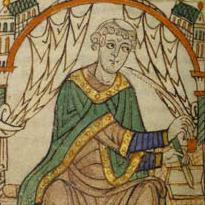
This portrait of Eadmer sharpening his quill was done a couple of decades after his death. The papal legate he writes about below was Guy, Archbishop of Vienne and future Pope Calixtus II.
The Concordat of London [3]
The papacy's third attempt to increase its control of Britain was met with success. A quarter-century after the failed attempt to secure fealty from William I Pope Paschal II managed, by threatening to excommunicate the king, to get Henry I to sign the world's first concordat.
Henry and all other secular overlords lost the power to appoint bishops and abbots. The English Church was now a department of the universal or Roman Church, which was no longer just an expression or an idea, but a real working organisation with its own law, courts and rights over property. It was also growing: the number of monks in England rose from about 1000 in 1066 to 13,000 by 1215. [4]
The national church wielded secular power in the kingdom. Government business that required literacy was carried out by clerics, the church owned much of the land and when the king was away the Archbishop of Canterbury ruled as regent. The Concordat of London talks about the symbolic objects in the ceremony of investiture, but the change in liturgy reflects a new level of papal control over Britain. Henry I could no longer invest bishops with the symbols of Church authority, the crook and ring, as his father and brother had done, but merely receive their homage, a face-saving gesture. As before, the archbishop’s badge of office, his stole (pallium), had to be fetched from Rome. No text survives of the world's first concordat, only this summary by an eye-witness, the monk Eadmer.
Aftermath: “the sword of St. Peter”
The following year, when Henry I realised that the German king was not bound by any concordat restrictions, he decided not to observe them himself. Thereupon the pope assured him that the Germans were next:
We have indeed waited anxiously to see that uncultured race become more civilised; but as for the King, if he persists in adhering to the wicked ways of his father, he will most certainly feel the sword of St. Peter which we have already begun to draw. [5]
The result of this was the Concordat of Worms (1122), modelled on its London predecessor, which fatally weakened the power of the German king. [6] Germany became splintered among princelings, both dukes and abbots. In the course of the Middle Ages the king gradually lost even his remaining holdings as he leased his imperial estates and was obliged to grant the imperial cities ever more freedom. Germany did not recover until its unification in the 19th century.
Notes
1. Terry Jones and Alan Ereira, Terry Jones’ Medieval Lives, (BBC Books, 2004), p. 7.
2. Lester B. Orfield, The Growth of Scandinavian Law, University of Pennsylvania Press, 1953, p. 37.
3. The Catholic Encyclopedia acknowledges London as the first concordat, however, today the Vatican doesn't mention it. There are many possible reasons for preferring to call the German Concordat of Wurms the first one: the present pope is German, Germany still has concordats and the 900th anniversary of the German one is coming up in 2022. On the other hand, the London concordat got cancelled by the Reformation and, although the Vatican lost its text, a published account of the negotiations still exists which, in pious prose, outlines Vatican tactics: Eadmer's History of Recent Events in England [Historia novorum in Anglia], translated by Geoffrey Bosanquet, (London, 1964).
4. Terry Jones and Alan Ereira, Terry Jones’ Medieval Lives, (BBC Books, 2004), p. 97.
5. Paschal II to Anselm (Archbishop of Canterbury), 12 October 1108. G. Bosanquet, ed., Eadmer's History of Recent Events in England, (London, 1964), p. 217.
6. Dr. Stefan Grathoff, “Zur geschichtlichen Entwicklung am Mittelrhein”. http://www.regionalgeschichte.net/hauptportal/bibliothek/texte/geschichte-mittelrhein.html

