



 Vatican Foreign Ministers: Lajolo (2004-2006) on concordat diplomacy
Archbishop Lajolo, former foreign minister of the Holy See, gives an update on papal diplomacy in the course of the two talks outlined here. He claims that concordats protect “religious freedom” and attempts to justify signing them with brutal regimes.
Archbishop Giovanni Lajolo is a graduate in Canon Law and Vatican career diplomat. As nuncio (papal ambassador) to Germany he negotiated the recent German concordats. He served as Secretary for Relations with States, the Vatican's foreign minister, from 2003 until 2006. That was the year he tried to finalise the Slovak “conscience concordat” (and after that was hoping for another one on state subsidies for the Church). However, EU legal experts warned of damage this could do to the human rights of the Slovaks, and after that scandal, Lajolo's “conscience concordat” was put on ice.
Without directly mentioning concordats he has emphasised the necessity of respecting these treaties, despite the questionable means by which many of them were brought in:
Pact sunt servanda ("agreements are to be respected") is one of the first principles of international law, and the pope has forcefully called attention to this [...] [1]
♦ In a talk held in May 2004 Lajolo stressed the need for concordats in Africa: 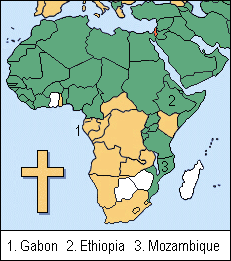
With them the presence of the Church in Africa no longer rests on the goodwill of political leaders but exists within a stable and clear legal framework that assures the local Church freedom of organization and action, as well as the possibility of continuing its educational and charity work free from interference. [2]
He mentions signing a concordat with Gabon in December 1997 and ongoing concordat negotiations with two other African countries, Ethiopia and Mozambique.
♦ On 15 November 2004, a few days before he took charge of Vatican diplomacy, Archbishop Lajolo gave a talk in Rome on “The Diplomacy of the Holy See in the Twentieth Century: Types of Concordats”. [3]
In his talk Archbishop Lajolo said that concordats have “the aim of regulating Church life in various countries in accordance with [Canon Law]”. The concern, however, is that it is not "Church life", but society as a whole which is to be governed in accordance with Canon Law: this is a particular danger posed by Church-run (but state-funded) social services.
The archbishop went on to explain that concordats are made with countries, rather than with their governments.
...The Holy See has sometimes been criticized for concluding agreements even with totalitarian regimes, in some way providing them with moral support and facilitating their presence on the international stage. However, it should be remembered, first of all, that by such agreements the Holy See has never recognized any specific regime. [4]
Cardinal Faulhaber, (who ordained Benedict XVI), apparently thought otherwise. As he put it in a sermon delivered in 1937:
At a time when the heads of the major nations in the world faced the new Germany with cool reserve and considerable suspicion, the Catholic Church, the greatest moral power on earth, through the Concordat expressed its confidence in the new German government. This was a deed of immeasurable significance for the reputation of the new government abroad. [5]
Lajolo continues his attempt to justify making concordats with dictators:
According to the norms of international law, it is the State (which remains) that concludes an agreement, and not governments or regimes (which come and go).
This is certainly true. Most of the concordats with Fascist regimes have remained in force with varying degrees of modification, (and in the case of Germany, very few). Lajolo offers no apology for the fact that the concordats were imposed on these states by dictators, including a number of (unexcommunicated) mass murderers.
Nor can it be forgotten that, in concluding its agreements, the Holy See aims to protect the freedom of the Church in a country, and the right of individual faithful and citizens to religious freedom, and this can prove to be even more necessary precisely when those who govern a country do not fully respect fundamental rights. [6]
Unfortunately, the historical record does little to support his contention. Concordats made with dictators involve two powerful institutions, each attempting to extract advantages from the pact, with little thought for the "fundamental rights" of its citizens.
Instead, they are used as pawns in the power game. In return for the dictator granting privileges to the Church, the Church tells the faithful to support the dictator. Clear examples of this are Hitler's 1933 election posters which instruct Catholics to vote him in because he has given the Church privileges in the recent concordat and the papal nuncio has indicated his approval.
Notes
1. John L. Allen Jr., "Interview with Archbishop Giovanni Lajolo", National Catholic Reporter,
14 January 2004. http://www.natcath.org/mainpage/specialdocuments/lajolo.htm
2. Giovanni Lajolo, "The possible renaissance of a continent", talk given on 21 May 2004 at a session on “The economic and social development of Africa in an era of globalization” organised in the Vatican by the Pontifical Council for Justice and Peace. http://www.30giorni.it/articoli_id_4003_l3.htm
3. Giovanni Lajolo, “The Diplomacy of the Holy See in the Twentieth Century: Types of Concordats”, talk at a congress promoted by the Polish embassy to the Holy See, 15 November 2005.
A brief summary: “Why Holy See Signs Concordats on Religious Liberty: Archbishop Lajolo Explains the Goal”, Zenit, 15 November 2005. http://www.zenit.org/en/articles/why-holy-see-signs-concordats-on-religious-liberty
A fuller summary: “Holy See Diplomacy”, Vatican Information Service,15 November 2005. http://www.ewtn.com/vnews/getstory.asp?number=62441
4. “Holy See Diplomacy”, Vatican Information Service,15 November 2005. http://www.ewtn.com/vnews/getstory.asp?number=62441
5. Cardinal Michael von Faulhaber, homily in Munich, 14 February 1937.
6. “Holy See Diplomacy”, Vatican Information Service,15 November 2005. http://www.ewtn.com/vnews/getstory.asp?number=62441

