



 Concordat agenda, 1075: the “Papal dictation”
This internal Vatican memo dictated by Gregory VII sets his agenda for increasing papal power, and underlies his demand that William the Conqueror pay him fealty. The English king's refusal helped shift the power struggle from outright Vatican sovereignty of Christian nations to Vatican control over their bishops, (the “investiture controversy”), and led to the earliest concordats.
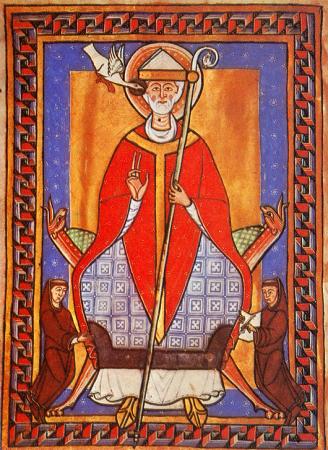 Here the dove of the Holy Ghost inspires Saint Gregory, while a monk at his feet takes down his words. This is the theory behind the Papal dictation. This document was written on piece of parchment placed in the papal registers of Gregory VII for the year 1075. [1]
Gregory's plan for reining in kings and ruling Europe
It was never signed by Gregory, much less published. It’s far too frank for that. For instance his Dictation clearly states that the pope has the right to depose, reinstate and transfer bishops (nos. 3, 4, 13, 25). However, such bald assertions would have scuttled the later concordat negotiations in London, where the King’s face was saved by permitting him to receive the empty “homage”, of the clerics he could no longer invest. [2]
Here Gregory claims the right to dissolve the bonds of fealty between a vassal and his lord which is what held mediaeval society together. Fealty involved six duties: to keep his lord safe, to protect him from harm, to preserve the lord’s justice, to prevent damage to his possessions, and to assist and not hinder his lord in the carrying out of his duties. [3] Gregory asserts that the pope is a saint (a harbinger of the 1870 doctrine of papal infallibility) with the right to appoint and remove bishops, depose emperors and “be judged by no one”. Europe was to become a theocracy ruled by the saint at the Vatican.
Even though this blunt memo was not signed by Gregory, scholars agree that “these short, aphoristic descriptions of papal power and authority [...] are congruent with his other letters, thought, and actions.” [4]
Gregory VII’s other fateful reform: clerical celibacy
In 1074, about the same itme as Gregory tightened up papal authority by way of the Dictation, he also reinforced his authority among the clergy by making the Church their only “family”. [5]
According to the political scientist Francis Fukuyama:
the instinct to favor family never disappears and will reassert itself whenever possible. To create a loyal administrative class ... some states took the extreme measure of destroying the family, in a variety of original ways.
The Chinese emperors instituted a special cadre of eunuchs who had no family but the state, and came to be trusted more than the regular administrators. Pope Gregory VII in the 11th century imposed celibacy on Catholic priests, forcing them to choose between the church and the family. [6]
The “Gregorian Reform” has left the Catholic Church with three enduring features: a centralist-absolutist papacy, compulsory clericalism (“Father knows best”) and the obligation of celibacy for clerics. [7]

Dictatus papae (Papal dictation), 1075
That the Roman church was founded by God alone.
- That the Roman pontiff alone can with right be called universal.
- That he alone can depose or reinstate bishops.
- That, in a council, his legate, even if a lower grade, is above all bishops, and can pass sentence of deposition against them.
- That the pope may depose the absent.
- That, among other things, we ought not to remain in the same house with those excommunicated by him.
- That for him alone is it lawful, according to the needs of the time, to make new laws, to assemble together new congregations, to make an abbey of a canonry; and, on the other hand, to divide a rich bishopric and unite the poor ones.
- That he alone may use the imperial insignia.
- That of the pope alone all princes shall kiss the feet.
- That his name alone shall be spoken in the churches.
- That this is the only name in the world.
- That it may be permitted to him to depose emperors.
- That he may be permitted to transfer bishops if need be.
- That he has power to ordain a clerk of any church he may wish.
- That he who is ordained by him may preside over another church, but may not hold a subordinate position; and that such a one may not receive a higher grade from any bishop.
- That no synod shall be called a general one without his order.
- That no chapter and no book shall be considered canonical without his authority.
- That a sentence passed by him may be retracted by no one; and that he himself, alone of all, may retract it.
- That he himself may be judged by no one.
- That no one shall dare to condemn one who appeals to the apostolic chair.
- That to the latter should be referred the more important cases of every church.
- That the Roman church has never erred; nor will it err to all eternity, the Scripture bearing witness.
- That the Roman pontiff, if he have been canonically ordained, is undoubtedly made a saint by the merits of St. Peter; St. Ennodius, bishop of Pavia, bearing witness, and many holy fathers agreeing with him. As is contained in the decrees of St. Symmachus the pope.
- That, by his command and consent, it may be lawful for subordinates to bring accusations.
- That he may depose and reinstate bishops without assembling a synod.
- That he who is not at peace with the Roman church shall not be considered catholic.
- That he may absolve subjects from their fealty to wicked men.
Source:
Ernest F. Henderson, Select Historical Documents of the Middle Ages, (London: George Bell and Sons, 1910), pp. 366-367.
http://www.fordham.edu/halsall/source/g7-dictpap.html
Notes
1. Ken Pennington, Professor of Ecclesiastical and Legal History, The Catholic University of America. http://faculty.cua.edu/pennington/Canon%20Law/GregorianReform/Dictatuspapae.htm
2. “Eadmer’s account of the Concordat of London, 1107.” http://www.concordatwatch.eu/showtopic.php?org_id=889&kb_header_id=877 Eadmer's History of Recent Events in England [Historia novorum in Anglia], translated by Geoffrey Bosanquet, (London, 1964), pp. 164-66.
3. This list of six feudal obligations was written by Bishop Fulbert of Chartres about 1020. Prof. Ken Pennington, “The Formation of the Jurisprudence of the Feudal Oath of Fealty”, Rivista internazionale del diritto comune 15, (2004) http://faculty.cua.edu/Pennington/Feudal%20OathBrundage.htm
4. Prof. Ken Pennington, The Catholic University of America.
http://www.maxwell.syr.edu/maxpages/classes/His311/Lecture%20One/Dictatuspapae.htm
5. Oliver J. Thatcher, ed., “60.: Prohibition of Simony and of the Marriage of the Clergy, 1074 ad”, A Source Book for Mediaeval History. Selected Documents Illustrating the History of Europe in the Middle Age, 1905.
http://oll.libertyfund.org/?option=com_staticxt&staticfile=show.php%3Ftitle=2277&chapter=215130&layout=html&Itemid=27
Prohibition of Simony and of the Marriage of the Clergy, 1074 AD
Pope Gregory [VII] held a synod in which he anathematized all who were guilty of simony. He also forbade all clergy who were married to say mass, and all laymen were forbidden to be present when such a married priest should officiate. In this he seemed to many to act contrary to the decisions of the holy fathers who have declared that the sacraments of the church are neither made more effective by the good qualities, nor less effective by the sins, of the officiating priest, because it is the Holy Spirit who makes them effective.
6. Nicholas Wade, “From ‘End of History’ Author, a Look at the Beginning and Middle”, New York Times, 7 March 2011. http://www.nytimes.com/2011/03/08/science/08fukuyama.html
7. Hans Küng, “A Vatican Spring?” New York Times, 2013-02-27. http://www.nytimes.com/2013/02/28/opinion/a-vatican-spring.html
Clericalism was defined by Fr. Richard J. Neuhaus, (Religion & Society Report, June 1989) as “the problem of a caste that arrogates to itself undue authority, that makes unwarranted claims to wisdom, even to having a monopoly on understanding the mind of God”.

