



%%rimage[Queen Isabel II's concordat (1851) : text]=X845_727_ESIsabel2logo_t55.jpg Queen Isabel II's concordat (1851) : text
To guard against the spectre of democracy, the 1851 concordat gave the Church a religious monopoly and control of education and the press. Isabel II, a weak monarch, got only a face-saving vestige of royal patronage. Her concordat was abrogated by the Second Spanish Republic in 1931, but General Franco revived its first four articles in his 1941 Convention, including the requirement that Catholicism be "the sole religion" in Spain.
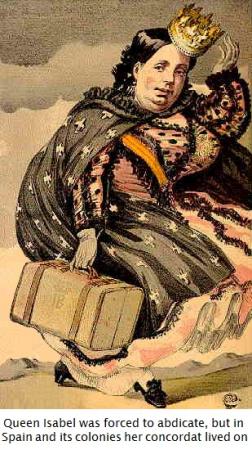 Queen Isabel II relied upon reactionary generals, conservative politicians and the Church. She was finally forced to abdicate in 1868, but her concordat lasted until 1931, when it was thrown out by a Republican government. Ten years later it was revived when Franco's 1941 Convention with the Vatican restored its first four articles.
Articles 5 to 9 redraw the boundaries of the dioceses in order to conform to the civil land divisions, as a matter of efficiency. [1]
However, other parts of this document give a revealing glimpse of the deal between the monarch and the Vatican which was known as royal patronage (patronato real). "Her Catholic Majesty" is to keep Catholicism the only religion permitted in her kingdom (art.1) and ensure that it is taught everywhere, even in the state schools (art.2). Royal patronage also means state censorship at the behest of the Church (art. 3). By this time books objectionable to the Church were no longer burnt, as they had been under the Inquisition — through this concordat they were prevented from even being printed:
Her Majesty and her royal Government shall, moreover, grant their mighty patronage and support to the bishops where they so request, principally where they need to oppose the malignancy of men who try to pervert the minds of the faithful and corrupt their mores, or where the publication, introduction or circulation of wicked and noxious books must be prevented.
The Queen's subjects must also pay the wages of archbishops and bishops and a guarantee that they "shall keep their palaces and the gardens, orchards or houses" (art. 31). They must also foot the bill for the wages of lower clerics, payments to churches and seminaries. (art. 32-35). And naturally all this does "not preclude increases" (art. 36)
In return, the Queen is to be allowed to appoint some clerics, though the pope controls the appointment of the bishops. (art. 18 and 26) This is only a face-saving device for the Queen, who is not given the rights of King Ferdinand and the first Queen Isabel. These monarchs, who were spreading Christianity with the sword in Europe and oveseas, secured the right to nominate the bishops subject to papal approval.
However, the position of Isabel II was much weaker. Though the democratic revolution of 1848 did not spread to Spain, its spectre strengthened the position of the Church. The throne wanted support from the pulpit to help foster the deference so necessary to counteract the heresies of liberty and equality. The price it paid was a new concordat in which it lost the substance of the "royal patronage".
Concordat enforced by penal code
A few months later the concordat was given teeth through a draconian penal code, which inflicted imprisonment and exile for “any attempt to change the religion of Spain, for public worship in other faiths, for apostatising from [leaving] Catholicism, or for publishing doctrines in opposition to it”. The Spanish bishops even called for the revival of the Inquisition under their management. However, this would have been superfluous, since the new penal code proved quite sufficient for the repression of religious dissent. [3]
Concordat concluded between His Holiness and Her Catholic Majesty, signed at Madrid on 16 March 1851
[Came into force on 11 May 1851 by the exchange of the instruments of ratification,
which took place at Madrid, in accordance with article 46]
His Holiness the Supreme Pontiff Pius IX, strongly desiring to provide forthe good of the religion and the utility of the Church of Spain with the pastoral solicitude with which he tends to all faithful Catholics and with especial benevolence toward the illustrious and devout Spanish Nation, and Her Majesty the Catholic Queen Isabel II, being possessed of the same desire owing to the piety and sincere adherence to the Apostolic See inherited from her ancestors, have decided to conclude a solemn concordat to govern all ecclesiastical affairs in a stable, canonical manner.
To this end, His Holiness the Supreme Pontiff has appointed as his Plenipotentiary His Excellency Mr. Juan Brunelli, Archbishop of Salonika, Domestic Prelate of His Holiness, Assistant to the Pontifical Throne and Papal Nuncio to the Kingdom of Spain with the powers of legate a latere, and Her Majesty the Catholic Queen has appointed Mr. Manuel Bertran de Lis, Knight Grand Cross of the royal and distinguished Spanish order of Charles III, of the order of Saint Maurice and Saint Lazarus of Cerdena and of the order of Francis I of Naples, member of Parliament and her Minister of State, who, having exchanged their full powers, found in good and due form, have agreed as follows:
Article 1
The apostolic Roman Catholic religion, which, to the exclusion of any other cult, continues to be the sole religion of the Spanish Nation, shall be preserved always in the dominions of Her Catholic Majesty, with all the rights and prerogatives which it should enjoy according to the law of God and the provisions of the sacred canons.
Article 2
Consequently, instruction in universities, colleges, seminaries and public or private schools of any nature shall be in all respects in keeping with the doctrine of the said Catholic religion; to that end, bishops and other diocesan prelates charged by virtue of their ministry with watching over the purity of the doctrine, the faith and mores and over the religious education of the youth shall in no way be hindered in the exercise of that charge, even in public schools.
Article 3
Nor shall the said prelates or other sacred ministers be hindered in any way in the exercise of their functions, nor shall anyone disturb them under any pretext in connection with the performance of the duties of their office; rather, all the authorities of the Kingdom shall take care to give them and see to it that they are given due respect and consideration in accordance with the divine precepts and that nothing is done which might cause them to suffer any blemish or scorn. Her Majesty and her royal Government shall, moreover, grant their mighty patronage and support to the bishops where they so request, principally where they need to oppose the malignancy of men who try to pervert the minds of the faithful and corrupt their mores, or where the publication, introduction or circulation of wicked and noxious books must be prevented.
Article 4
In all other matters pertaining to the right and exercise of ecclesiastical authority and the ministry of the holy orders, the bishops and the clergy subordinate to them shall enjoy the full freedom established by the sacred canons.
Article 5
Owing to the cogent reasons of necessity and advantage which thus impel, for the sake of greater convenience and spiritual utility to the faithful a new division and circumscription of dioceses shall be made throughout the Peninsula and adjacent islands. To this end, the present metropolitan sees of Toledo, Burgos, Granada, Santiago, Seville, Tarragona, Valencia and Saragossa shall be maintained and the suffragan see of Valladolid shall be raised to the rank of metropolitan see.
The suffragan dioceses of Almeria, Astorga, Avila, Badajoz, Barcelona, Cadiz, Calahorra, the Canaries, Cartagena, Cordova, Coria, Cuenca, Gerona, Guadix, Huesca, Jaen, Jaca, L on, L rida, Lugo, Malaga, Majorca, Minorca, Mondonedo, Orense, Orihuela, Osma, Oviedo, Palencia, Pamplona, Plasencia, Salamanca, Santander, Segorbe, Segovia, Sigiienza, Tarazona, Teruel, Tortosa, Tuy, Urgel, Vich and Zamora shall also be maintained.
The diocese of Albarracfn shall be united to that of Teruel, that of Barbastro to that of Huesca, that of Ceuta to that of Cadiz, that of Ciudad Rodrigo to that of Salamanca, that of Ibiza to that of Majorca, that of Solsona to that of Vich, that of Tenerife to that of the Canaries and that of Tudela to that of Pamplona.
The prelates of the sees to which others are united shall add, to the title of bishop of the church over which they preside, that of the church united to it.
New suffragan dioceses shall be established in Ciudad Real, Madrid and Vitoria.
The episcopal see of Calahorra and la Calzada shall be transferred to Logrofio, that of Orihuela to Alicante and that of Segorbe to Castell n de la Plana, when in those cities everything is ready therefor and it is deemed opportune after the respective prelates and chapters have been heard.
In cases in which, for the better service of a diocese, an auxiliary bishop is needed, provision for such need shall be made in accordance with the customary canonical procedure.
Similarly, vicars-general shall be established at points where, owing to the union of dioceses provided for in this article or for any other just cause, they are deemed necessary, the respective prelates being heard.
At Ceuta and on Tenerife auxiliary bishops shall immediately be established.
Article 6
The distribution of the said dioceses, as relates to subordination to their respective metropolitan sees, shall be as follows:
Those of Calahorra or Logroñio, León, Osma, Palencia, Santander and Vitoria shall be suffragan to the metropolitan church of Burgos;
Those of Almería, Cartagena or Murcia, Guadix, Jaen and Málaga shall be suffragan to the metropolitan church of Granada;
Those of Lugo, Mondoñedo, Orense, Oviedo and Tuy shall be suffragan to the metropolitan church of Santiago;
Those of Badajoz, Cadiz, Cordova and the Canary Islands shall be suffragan to the metropolitan church of Seville;
Those of Barcelona, Gerona, Lérida, Tortosa, Urgel and Vich shall be suffragan to the metropolitan church of Tarragona;
Those of Ciudad Real, Coria, Cuenca, Madrid, Plasencia and Sigüenza shall be suffragan to the metropolitan church of Toledo;
Those of Majorca, Minorca, Orihuela or Alicante, and Segorbe or Castellón de la Plana shall be suffragan to the metropolitan church of Valencia;
Those of Astorga, Avila, Salamanca, Segovia and Zamora shall be suffragan to the metropolitan church of Valladolid;
Those of Huesca, Jaca, Pamplona, Tarazona and Teruel shall be suffragan to the metropolitan church of Saragossa.
Article 7
The new boundaries and particular demarcation of the said dioceses shall be determined within the shortest possible time and in the proper manner (servatis servandis) by the Holy See, which shall therefore delegate to the papal nuncio to the kingdom of Spain the necessary powers for him to carry out such demarcation, reaching an agreement for that purpose (collatis consiliis) with Her Majesty's Government.
Article 8
All the right reverend bishops and their churches shall recognize canonical subordination to the respective metropolitans, and the exemptions of the bishoprics of León and Oviedo shall therefore cease.
Article 9
Whereas, on the one hand, it is necessary and urgent that an opportune remedy should be provided for the grave difficulties caused in the ecclesiastical administration by the scattered territory of the four military orders of Santiago, Calatrava, Alcántara and Montesa and, on the other hand, one must carefully preserve the glorious memories of an institution which has rendered so many services to the Church and the State and the prerogatives of the kings of Spain as grand masters of the said orders by apostolic concession, in the new ecclesiastical demarcation a certain number of neighbouring towns shall be designated, forming a district where the grand master may, as up to the present, exercise ecclesiastical jurisdiction entirely in accordance with the said concession and papal bulls.
The new territory shall be named Priorate of the Military Orders, and the prior shall rank as a bishop with Church title in partibus.
Towns which presently belong to the said military orders and are not included in their new territory shall be incorporated into the respective dioceses.
Article 10
The exercise of the authority and ordinary jurisdiction of the most reverend archbishops and the right reverend bishops shall extend to the entire territory included in their respective dioceses according to the new circumscription; consequently, those who have by any right hitherto exercised such authority and jurisdiction in districts enclaved in other dioceses shall cease to do so under the new circumscription.
Article 11
All privileged and exempt jurisdictions, whatever their nature and denomination may be, including that of Saint John of Jerusalem, shall also cease. Their present territories shall be united to the respective dioceses in the new demarcation of them to be made in accordance with article 7, except the following exemptions:
1. That of Her Majesty's Assistant Chief Chaplain (Pro-Capellan mayor);
2. That pertaining to the military;
3. That of the four military orders of Santiago, Calatrava, Alcántara and Montesa, in accordance with the terms set out in article 9 of this Concordat;
4. That of the regular prelates;
5. That of the apostolic nuncio pro tempore to the Italian's Hospital and Church of the Spanish Court.
The special powers belonging to the Office of the Commissioner-General of the Crusade shall also be maintained in respect of matters pertaining to his office by virtue of the brief of delegation and other apostolic measures.
Article 12
The Office of the Collector-General of Spolia, Vacantia and Annuities is abolished and the commission for administering vacant effect, collecting arrears and prosecuting and terminating pending business is attached for the present to the Office of the Commissioner-General of the Crusade.
Also abolished is the Apostolic and Royal Tribunal of the Favour of Exemption (Tribunal Apostólico y Real de la Gracia del Excusado).
Article 13
The chapter of cathedral churches shall be composed of the dean, whose seat shall always be the first post pontificalem ; four dignitaries, to wit: archpriest, archdean, precentor and maestrescuela (teacher of divinity), in addition to the treasurer in metropolitan churches; four major canons, to wit: the magistral, the doctoral, the lectoral and the plenipotentiary and the number of minor canons stated in article 17.
In addition, there shall be, in the church of Toledo, two other dignities with the respective titles Chief Chaplain of Kings (Capellán mayor de Reyes) and Chief Chaplain of Mozarabs (Capellán mayor de Muzárabes); in the church of Seville, the dignity of Chief Chaplain of Saint Ferdinand (Capellán mayor de San Fernando); in the church of Granada, that of Chief Chaplain of the Catholic Kings (Capellán mayor de los Reyes Católicos); and in the church of Oviedo, that of Rector of Covadonga.
All the members of the chapter shall have an equal voice and vote therein.
Article 14
Prelates may convoke and preside over the chapter whenever they deem appropriate; similarly, they may preside over examinations in competitions for prebends.
In these and any other acts, prelates shall always occupy a preferred position and no privilege or custom to the contrary shall stand in the way thereof; all homage shall be paid to them in keeping with the consideration and respect due to them by virtue of their holy character and their capacity as head of their church and chapter.
Whenever they preside, they shall have a voice and vote in all matters not directly involving them personally; moreover, their vote shall be decisive in thecase of equality of votes.
In any election or appointment of persons which is the duty or right of the chapter, the prelate shall have three, four or five votes, according as the number of members of the chapter is 16, 20 or greater than 20. In such cases, when the prelate does not attend the chapter, he shall draw up a commission for receiving his votes.
When the chapter is not presided over by the prelate, it shall be presided over by the dean.
Article 15
Inasmuch as the cathedral chapters are the senate and council of the most reverend archbishops and the right reverend bishops, the latter shall consult the chapters in order to hear their opinion or obtain their consent in the manner provided by canon law and especially by the holy Council of Trent, in consideration of the varied nature of the different affairs and cases. All such immunities, exemptions, privileges, practices or abuses as may have in any way become introduced into the different churches of Spain in favour of the chapters to the detriment of the ordinary authority of the prelates shall therefore cease forthwith.
Article 16
In addition to the dignitaries and canons who exclusively make up the chapter, in cathedral churches there shall be assistant chaplains or beneficiaries, with the corresponding number of other ministers and dependants.
Thus the dignitaries and canons, and also the beneficiaries or chaplains, though divided, for the better service of the respective cathedrals, into sacerdotal, diaconal and subdiaconal, must all be priests, as ordered by His Holiness, and those who are not so on taking possession of their benefices must necessarily be so within a year, subject to the canonical penalties.
Article 17
The number of capitulars and beneficiaries in metropolitan churches shall be as follows:
The churches of Toledo, Seville and Saragossa shall have 28 capitulars; the church of Toledo shall have 24 beneficiaries; that of Seville, 22; and that of Saragossa, 28.
The churches of Tarragona, Valencia and Santiago shall have 26 capitulars and 20 beneficiaries, and those of Burgos, Granada and Valladolid, 24 capitulars and 20 beneficiaries.
The suffragan churches shall respectively have the numbers of capitulars and beneficiaries stated below:
Those of Barcelona, Cadiz, Cordova, León, Malaga and Oviedo shall have 20 capitulars and 16 beneficiaries. Those of Badajoz, Calahorra, Cartagena, Cuenca, Jaen, Lugo, Palencia, Pamplona, Salamanca and Santander shall have 18 capitulars and 14 beneficiaries. Those of Almería, Astorga, Avila, the Canaries, Ciudad Real, Coria, Gerona, Guadix, Huesca, Jaca, Lérida, Majorca, Mondoñedo, Orense, Orihuela, Osma, Plasencia, Segorbe, Segovia, Sigüenza, Tarazona, Teruel, Tortosa, Tuy, Urgel, Vich, Vitoria and Zamora shall have 16 capitulars and 12 beneficiaries.
That of Madrid shall have 20 capitulars and 20 beneficiaries and that of Minorca, 12 capitulars and 10 beneficiaries.
Article 18
In subrogation of the 52 benefices referred to in the Concordat of 1753, the dignity of precentor in all metropolitan churches and in the suffragan churches of Astorga, Avila, Badajoz, Barcelona, Cadiz, Ciudad Real, Cuenca, Guadix, Huesca, Jaen, Lugo, Malaga, Mondoñedo, Orihuela, Oviedo, Plasencia, Salamanca, Santander, Sigüenza, Tuy, Vitoria and Zamora shall be reserved for free provision by His Holiness, and in the remaining suffragan churches, a minor canonry, which shall be determined by the first provision to be made by His Holiness. These benefices shall be granted in accordance with the said Concordat.
Provision to the dignity of dean shall always be made by Her Majesty in all churches and at whatever time and in whatever manner it becomes vacant. Major canons shall be provided, following a competition, by the prelates and chapters. Provision to the remaining dignities and canonries shall be made with rigorous alternation by Her Majesty and the respective archbishops and bishops. Assistant chaplains or beneficiaries shall be appointed alternately by Her Majesty and the prelates and chapters.
Where the said prebends, canonries and benefices become vacant owing to resignation or promotion of the possessor to another benefice, provision to them shall always and in all cases be made by Her Majesty, provided that they are not among those reserved to His Holiness.
The same shall be true of those which become vacant sede vacante or to which no provision has been made by the prelates or persons responsible for making such provision at the time of the death, transfer or resignation.
The first provision to the dignities, canonries and chaplaincies of new cathedrals and to those added in the new metropolitan cathedral of Valladolid shall also belong to Her Majesty, with the exception of those reserved to His Holiness and the major canonries, to which provision shall be made in the ordinary manner.
In every case those appointed to the said benefices must be given canonical institution and collation by their respective Ordinaries.
Article 19
Inasmuch as, both as a result of past vicissitudes and under the provisions of this Concordat, there have been appreciable changes in the circumstances of the Spanish clergy, His Holiness and Her Majesty the Queen agree that no dignity, canonry or benefice requiring personal residence shall be granted to persons who, by reason of any other charge or commission, are required to reside continuously elsewhere. Nor shall any such charge or commission be granted to persons in possession of any benefice of the said nature unless they renounce one of those charges or benefices, which are therefore declared incompatible in every respect.
In the royal chapel, however, there may be up to six prebendaries of the cathedral churches of the Peninsula; in no case, however, may those occupying the first seats, major canons, those having cure of souls or two from the same church be appointed.
In respect of persons who, under special or general induits, are at present in possession of two or more such benefices, charges or commissions, the necessary measures for bringing their situation into conformity with the provisions of this article shall be taken forthwith in accordance with the needs of the Church and the nature of each case.
Article 20
In the case of a vacant bishopric, the chapter of the metropolitan or suffragan church shall, within the designated period and in accordance with what is laid down by the holy Council of Trent, appoint a single capitular vicar, in whose person there shall be contained all the ordinary power of the chapter without any reservation or limitation on the part thereof, and provided that the appointment, once made, shall not be revoked and that no other new appointment shall be made; every privilege, practice or custom of administering as a body or of appointing more than one vicar and every other which is for any reason contrary to the provisions of the sacred canons is therefore entirely abolished.
Article 21
In addition to the chapel of the royal palace, the following shall be maintained:
1. The Chapel of Kings and the Mozarab Chapel in Toledo, and the Chapels of Saint Ferdinand in Seville and of the Catholic Kings in Granada;
2. The collegiate churches situated in provincial capitals where no episcopal see exists;
3. Those of private patronage whose patrons guarantee any cost to which the collegiate church may give rise in excess of the cost of a parochial church;
4. The collegiate churches of Covadonga, Roncesvalles, San Isidro de Léon, Sacromonte de Granada, San Ildefonso, Alcalá de Henares and Jerez de la Frontera;
5. The cathedral churches of episcopal sees united to others pursuant to this Concordat shall be kept as collegiate churches.
All other collegiate churches, whatever their origin, antiquity or foundation, shall be reduced, where local circumstances do not stand in the way, to parochial churches having such number of beneficiaries in addition to the pastor as is deemed necessary both for parochial service and for the decorum of worship.
The maintenance of the said chapels and collegiate churches must in all cases be understood as involving subjection to the prelate of the diocese to which they belong and the abolition of any exemption or jurisdiction vere or quasi nullius which limits, however slightly, the jurisdiction proper to the Ordinary.
Collegiate churches shall in all cases be parochial and shall be distinguished by the name of the major parish, where another or others exist in the town.
Article 22
The chapter of collegiate churches shall be composed of a presiding rector, who shall additionally have cure of souls but whose authority or jurisdiction over his church and chapter shall be administrative and economic only, two major canons with the titles magistral and doctoral, and eight minor canons. In addition there shall be six assistant chaplains or beneficiaries.
Article 23
The rules laid down in the preceding articles both for provision to the prebends and benefices or chaplaincies of cathedral churches and for the system governing their chapters shall be faithfully observed in all their parts in respect of collegiate churches.
Article 24
In order that in all the towns of the Kingdom attention may be given with due nicety to religious worship and to all the needs of spiritual nourishment, the most reverend archbishops and the right reverend bishops shall immediately undertake to form a new arrangement and parochial demarcation of theirrespective dioceses, taking into account the extent and nature of the territory and of the population and all other local circumstances, hearing the cathedral chapters, the respective archpriests and the prosecutors of the ecclesiastical courts, and for their own part taking all the necessary measures in order for the said arrangement to be able to be deemed concluded and carried into effect, following approval by Her Majesty's Government, in the shortest possible time.
Article 25
No chapter or ecclesiastical corporation may have attached to it the cure of souls, and the perpetual cures and vicariates which had previously been united plena jure to any corporation shall be in every respect subject to civil law. The coadjutors and employees of the parishes and all ecclesiastics intended for the service of hermitages, sanctuaries, oratories, public chapels or non-parochial churches shall be under the rector of their respective territory and shall be subordinate to him in all matters pertaining to worship and religious functions.
Article 26
Provision to all cures, without distinction as to towns, classes or the time at which they become vacant, shall be made in an open competition in accordance with what has been laid down by the holy Council of Trent, with the Ordinaries forming ternas of approved candidates and directing them to Her Majesty in order that she may appoint one of the persons proposed. The privilege of birthright and the special privilege or preference which holders of birthrights had in some places for the obtainment of cures and other benefices shall consequently cease.
In provision to cures of ecclesiastical patronage, the patron shall make the nomination from among the persons in the terna formed by the prelates in the manner mentioned above, and in provision to those of lay patronage, the patron shall make the nomination from among those who prove that they have been approved in an open competition in the diocese in question, those who are not in that situation being given a period of four months to prove that their examinations, carried out in the indicated manner, have been approved, subject in all cases to the right of the Ordinary to examine the candidate presented by the patron, should he so see fit.
The coadjutors of the parishes shall be appointed by the Ordinaries, following synodal examination.
Article 27
Suitable measures shall be dictated for ensuring, in so far as possible, that the new ecclesiastical arrangement does not injure the rights of the present possessors of any prebends, benefices or charges which might have to be suppressed as a consequence of its provisions.
Article 28
Her Catholic Majesty's Government shall, without prejudice to the timely establishment, following a prior agreement with the Holy See and as soon as circumstances permit, of general seminaries providing proper extension of ecclesiastical studies, adopt, for its part, the appropriate measures for the creation, without delay, of conciliar seminaries in dioceses where none have been established, in order that subsequently there may be no church in the Spanish dominions which does not have at least one adequate seminary for the instruction of the clergy.
The seminaries shall admit, educate and instruct in the manner established by the holy Council of Trent, such youths as the archbishops and bishops may deem it suitable to receive, according to the needs of or utility to the dioceses; and in everything pertaining to the rule of the seminaries, teaching, and the administration of their property the decrees of the said Council of Trent shall beobserved.
If, as a result of the new circumscription of dioceses, some have two seminaries, one in the present capital of the bishopric and the other in the one to be united to it, both shall be maintained as long as the Government and the prelates are in agreement in considering them useful.
Article 29
In order for there to be throughout the Peninsula a sufficient number of ministers and evangelical workers of whom the prelates may avail themselves for carrying out missions among the people of their diocese, assisting parish priests and helping the sick and for other works of charity and public utility, Her Majesty's Government, which purposes to improve, as appropriate, the overseas mission colleges, shall immediately take suitable measures after hearing the diocesan prelates, for the establishment, wherever necessary, of religious houses and congregations of Saint Vincent de Paul, Saint Philip Neri and another of the orders approved by the Holy See, which shall serve at the same time as places of retreat for ecclesiastics, for the performance of spiritual exercises and for other pious uses.
Article 30
In order that there may also be houses of women religious in which women who are called to the life of contemplation and of action in assisting the sick, teaching children and other works and occupations as pious as they are useful to the people may follow their vocation, the institution of the Daughters of Charity shall be maintained, under the direction of the clerics of Saint Vincent de Paul, and the Government shall adopt measures for its promotion.
The houses of women religious who combine with the contemplative life the education and teaching of girls or other works of charity shall also be maintained.
As relates to the other orders, the ordinary prelates, considering all the circumstances of their respective dioceses, shall propose such houses of women religious as may be suitable for the admission and profession of novices and such exercises of teaching or charity as it may be fitting to establish in them.
No profession of any nun shall be undertaken unless her subsistence has first been duly ensured.
Article 31
The stipend of the Most Reverend Archbishop of Toledo shall be 160,000 reals yearly.
That of the archbishops of Seville and Valencia shall be 150,000.
That of the archbishops of Granada and Santiago shall be 140,000.
And that of the archbishops of Burgos, Tarragona, Valladolid and Saragossa shall be 130,000.
The stipend of the Right Reverend Bishops of Barcelona and Madrid shall be 110,000.
That of the bishops of Cadiz, Cartagena, Cordova and Malaga shall be 100,000.
That of the bishops of Almeria, Avila, Badajoz, the Canaries, Cuenca, Gerona, Huesca, Jaen, Léon, Lérida, Lugo, Majorca, Orense, Oviedo, Palencia, Pamplona, Salamanca, Santander, Segovia, Teruel and Zamora shall be 90,000 reals.
That of the bishops of Astorga, Calahorra, Ciudad Real, Coria, Guadix, Jaca, Minorca, Mondonedo, Orihuela, Osma, Plasencia, Segorbe, Sigiienza, Tarazona, Tortosa, Tuy, Urgel, Vich and Vitoria shall be 80,000 reals.
That of the Patriarch of the Indies, being neither archbishop nor bishop proper, shall be 150,000, there being deducted from that amount any other which he may collect, by way of ecclesiastical pension or otherwise, from the State.
Prelates who are cardinals shall have the benefit of 20,000 reals in addition to their stipend.
The auxiliary bishops of Ceuta and Tenerife and the priors of orders shall have 40,000 reals yearly.
These stipends shall not be subject to any discount either by reason of the cost of papal bulls, which shall be defrayed by the Government, or owing to any other costs to which such bulls may give rise in Spain.
In addition, archbishops and bishops shall keep their palaces and the gardens, orchards or houses that have been destined for their use and recreation in any part of the diocese and have not been alienated.
Archbishops and bishops may, in derogation of the present legislation relative to their spolia, freely dispose, in accordance with the dictates of their conscience,of whatever they may leave at the time of their decease, and their legitimate heirs shall succeed to them ab intestato with the same obligation of conscience, with the exception, in both cases, of sacred vestments and pontificals, which shall be deemed as belonging to the mitre and shall be transferred to their successors therein.
Article 32
The first chair of the cathedral church of Toledo shall have a stipend of 24,000 reals; those of the other metropolitan churches, 20,000; those of suffragan churches, 18,000; and those of collegiate churches, 15,000.
The dignitaries and major canons of metropolitan churches shall have 16,000 reals; those of suffragan churches, 14,000; and the major canons of collegiate churches, 8,000.
The remaining canons shall have 14,000 reals in metropolitan churches, 12,000 in suffragan churches, and 6,600 in collegiate churches.
Assistant chaplains or beneficiaries of metropolitan churches shall have 8,000 reals; those of suffragan churches, 6,000; and those of collegiate churches, 3,000.
Article 33
The stipend of parish priests in urban parishes shall be from 3,000 to 10,000 reals; in rural parishes the minimum stipend shall be 2,200.
Coadjutors and administrators (economos) shall have from 2,000 to 4,000 reals.
In addition, rectors, and also coadjutors, if any, shall have the benefit of the houses intended for their abode and such gardens, orchards or estates as have not been alienated and are known by such names as iglesarios, mansos or others.
Rectors and their coadjutors shall also have the benefit of their rightful share in surplice-fees and alterage.
Article 34
To defray the costs of worship, metropolitan churches shall have from 90 to 140,000 reals annually; suffragan churches, from 70 to 90,000; and collegiate churches, from 20 to 30,000.
For administrative expenses and extraordinary visitation expenses metropolitans shall have from 20 to 30,000 reals and suffragans, from 16 to 20,000.
For the costs of parochial worship the respective churches shall be allotted a yearly amount of no less than 1,000 reals in addition to any emoluments and the fees fixed or to be fixed for certain functions in the tariffs of the respective dioceses.
Article 35
The conciliar seminaries shall have from 90 to 120,000 reals yearly, according to their circumstances and needs.
Her Majesty's Government shall provide, by the most conducive means, for the subsistence of the religious houses and congregations discussed in article 29.
As for the maintenance of religious communities, the provisions of article 30 shall be observed.
The property belonging to those communities which is in the hands of the Government and has not been alienated shall be returned to them immediately and without delay, and on their behalf to the diocesan prelates in whose territory the convents are situated or were situated before the most recent changes. His Holiness, however, bearing in mind the present state of that property and other particular cirumstances, orders the prelates, on behalf of the owner religious communities, to proceed immediately and without delay to sell the said property at public auctions conducted in accordance with canonical precepts and with the participation of a person designated by Her Majesty's Government, in order that with the proceeds thereof the expenses of worship and other general expenses may be met with greater uniformity. The proceeds of such sales shall be converted into non-transferable 3% Government bonds, the principal and interest of which shall be distributed among all the above-mentioned convents in proportion to their needs and circumstances with a view to meeting the said expenses and paying the pensions of nuns entitled to receive them, provided, however, that the Government shall supply, as hitherto, whatever is necessary for the complete payment of such pensions until the decease of the pensioners.
Article 36
It is to be understood that the amounts allocated in the preceding articles for expenses of cult and clergy do not preclude increases in those amounts where circumstances so permit. Nevertheless, where for special reasons any of the allocations specified in article 34 does not suffice in a particular case, Her Majesty's Government shall provide accordingly; similarly, it shall provide for the costs of repairs to temples and other edifices consecrated to worship.
Article 37
The amount of annuity accruing during the vacancy of episcopal chairs, less the emoluments of the administrator to be deputed by the chapter in the act of electing the capitular vicar, and the costs of necessary repairs to the episcopal palace, shall be applied in equal parts in favour of the conciliar seminary and the new prelate.
Similarly, from the annuities accruing during the vacancy of dignities, canonries, parishes and benefices of each diocese, less the related charges, there shall be formed an accumulation or reserve fund available to the Ordinary fo meeting extraordinary and unforeseen expenses of churches and clergy and grave and pressing needs of the diocese. For the same purpose, an amount equivalent to one twelfth of the yearly stipend of persons newly appointed to prebends, parishes and other benefices shall likewise be added to the said reserve fund, being paid by them once, during the first year; every other discount previously effected on any ground or by reason of any practice, provision or privilege, shall therefore cease.
Article 38
The funds with which the endowment of worship and the clergy is to be provided shall be:
1. The proceeds of the property returned to the clergy by the law of 3 April 1845;
2. The proceeds of the alms of the Holy Crusade;
3. The proceeds of the commanderies and grandmasterships of the four military orders which are or become vacant;
4. An imposition on rural and urban property and livestock at the rate necessary to complete the endowment, account being taken of the proceeds specified in paragraphs 1, 2 and 3 and such other annuities as are subsequently earmarked for that purpose in agreement with the Holy See.
The clergy shall collect this imposition in produce, in kind or in cash, based on an agreement which it may conclude with provinces, towns, parishes or individuals, and in case of necessity it shall be assisted by the public authorities in the collection of the imposition, the measures established for the collection of contributions being applied to that end.
In addition, all ecclesiastical property not falling within the purview of the said law of 1845 and not yet alienated, including the remaining property of the men's religious communities, shall be returned to the Church immediately and without delay. However, considering the present circumstances of all of such property and the obvious profit which will inevitably accrue to the Church, the Holy Father orders that the principal thereof shall be converted immediately and without delay into non-transferable 3% Government bonds, with faithful observance of the form and rules laid down in article 35 in reference to the sale of the property of nuns.
All such property shall be credited at its fair value, less any charges, for the purposes of the provisions contained in this article.
Article 39
Subject to the inherent right of the diocesan prelates, Her Majesty's Government shall dictate the necessary provisions in order that those among whom the property of chaplaincies and pious foundations has been distributed shall ensure the means of performing the obligations to which that property is subject.
It shall adopt like provisions to ensure that pious obligations encumbering ecclesiastical property which has been alienated with that charge are performed in the same manner.
The Government alone shall at all times be responsible for the taxes on property which has been sold by the State free of that obligation.
Article 40
It is declared that all the said property and rents are owned by the Church, on whose behalf they are to be enjoyed and administered by the clergy.
Crusade funds shall be administered in each diocese by the diocesan prelates as invested for that purpose with the faculties of the papal bull in order to apply such funds as provided in the most recent extension of the relevant apostolic concession, subject to the obligations existing in this connection under conventions concluded with the Holy See. The manner and form in which such administration is to take place shall be established by agreement between the Holy Father and Her Catholic Majesty.
The diocesan prelates shall also administer the funds of the quadragesimal induit, employing them for benevolent establishments and acts of charity in their respective dioceses, in keeping with the apostolic concessions.
All other apostolic faculties relating to this sphere and the functions flowing from them shall be exercised by the archbishop of Toledo within the scope and in the manner to be determined by the Holy See.
Article 41
In addition, the Church shall have the right to make acquisitions in any lawful manner, and its title to everything which it possesses now or acquires hereafter shall be solemnly respected. Consequently, no suppression or union shall be effected in respect of old or new ecclesiastical foundations without the intervention of the authority of the Holy See, subject to the faculties belonging to bishops according to the holy Council of Trent.
Article 42
Such being the case, considering the utility which will inevitably accrue to the Religion from this Convention, the Holy Father, at the instance of Her Catholic Majesty and in order to promote public tranquillity, decrees and declares that persons who, during the past circumstances, purchased ecclesiastical property in the dominions of Spain under the provisions of civil law in force at the time and are in possession of such property and persons who have succeeded or may succeed to the rights of those purchasers will not be troubled at any time or in any manner by His Holiness or by the Supreme Pontiffs who succeed him, but that both they and their assigns shall rather safely and peacefully enjoy the ownership, profits and products of that property.
Article 43
Everything pertaining to ecclesiastical persons or things concerning which no provision is made in the foregoing articles shall be governed and administered in accordance with the discipline of the Church canonically in force.
Article 44
The Holy Father and Her Catholic Majesty declare that the royal prerogatives of the Crown of Spain under the conventions previously concluded between the two Powers remain sound and unharmed. Therefore, the said conventions, and in particular that concluded between the Pontifex Maximus Benedict XIV and the Catholic King Ferdinand VI in the year 1753, are declared confirmed and shall continue in full force in all respects in which they are not modified or amended hereby.
Article 45
The laws, orders and decrees published hitherto in any manner or form in the dominions of Spain shall, in pursuance of this Concordat, be deemed repealed in so far as they are opposed thereto, and this Concordat shall here after govern forever as law of the State in those dominions. Both Contracting Parties therefore promise, on their own behalf and on behalf of their successors, the faithful observance of each and every one of the articles of which it consists. Should any difficulty occur in the future, the Holy Father and Her Catholic Majesty shall come to an understanding in order to resolve it amicably.
Article 46 and last
The exchange of ratifications of this Concordat shall take place within a period of two months or, if possible, earlier.
In witness whereof, we the undersigned plenipotentiaries have signed this Concordat and sealed it with our own seals in Madrid on 16 March 1851.
Juan Brunelli
Archbishop of Salonika
Manuel Bertran de Lis
[Spanish Minister of State]
Source:
http://treaties.un.org/doc/Publication/UNTS/Volume%201221/volume-1221-II-874-English.pdf
Notes
1. “The territorial adaptation of the Spanish dioceses to the civil provinces was regarded as a efficiency measure. This was due to the quick increase of the population from the 18th c., the too vast territories of some bishoprics and the necessity of eliminating absurd enclaves from the past.” From the abstract in English of the document Concordato de 1851 y reordenación del territorio eclesiástico en España: La diócesis de Cartagena by Maria José Vilar, 2004.
http://cat.inist.fr/?aModele=afficheN&cpsidt=16438601
2. 2. Henry Charles Lea, A History of the Inquisition of Spain, (Macmillan, 1906-07), Vol. 4, Book 9, Chapter 1, p. 469. http://libro.uca.edu/lea4/9lea1.htm

