 Pope tightens rules twice to prevent church-leaving (2006 and 2010)
Faced with mass defections from the Catholic Church after the clerical abuse scandal broke, Benedict XVI tightened up the rules. Then in 2010 he changed canon law to remove the possibility of defection. And national bishops' conferences restrict the notation on baptismal registers of even the wish to defect. Here are church-leaving rules (as of 2011) for Austria, Belgium, Britain, Denmark, Finland, France, Germany, Iceland, Ireland, Italy, Netherlands, Poland, Spain, Sweden and Switzerland.
2002: The great exodus begins
Many of the desperate Irish immigrants fleeing the mid-19th-century potato famine landed in Boston and stayed there.
Catholic parishes became the center of family life, providing free education, hospitals, sports and numerous social activities, recreating to some degree the close-knit villages the Irish had loved back home while at the same time protecting them from unfriendly Americans. [1]
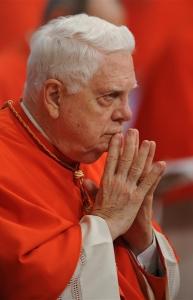 This made Boston a stronghold of Catholicism and even at the turn of the 21st century Cardinal Bernard Francis Law, Archbishop of the Diocese of Boston, was a very powerful figure. Then, in 2002 he faced an unprecedented challenge. The Boston Globe conducted an investigation, using Church documents, official testimony, and victim interviews, and at the beginning of the year began publishing the results. These showed how Cardinal Law and his administration had coddled abusive priests and permitted them to molest again, while stonewalling or paying off their victims. [2] By the end of the year the Cardinal had been forced to resign and departed for the Vatican. But there, to the distress of the victims and other disillusioned Catholics, he was put in charge of one of the four major basilicas in Christendom, and housed in a palatial apartment adorned with frescoes. [3] By that time the Boston archdiocese was facing a bill of $85 million in compensation claims from the hundreds of victims.
This was only the beginning. Similar clerical crimes and coverups were soon reported across the US and abroad. Many of the faithful were horrified and did not want their contributions to pay for Church misdeeds.
This set off a wave of Church-leaving, which the Vatican calls “defection” or “apostasy”. Not the least of the Vatican's problems was that this, in turn, reduced Church income. Something had to be done to discourage this.
Vatican tries to stem the outflow
♦ The first attempt to deal with the new situation of people wanting to leave the Church en masse came in 2006 when Benedict XVI sent a etter to bishops on “The formal act of defection from the Catholic Church”, (Actus formalis defectionis ab Ecclesia catholica). This was a theological challenge to the state's practice of allowing anyone to leave the Church at will. The Church insisted that there must be a "reception of that decision [to leave the Church] by the competent ecclesiastical authority". One couldn't do it merely by filling out the appropriate government forms. Only the Church could decide who might “defect”. And, of course, in countries where Church membership has no tax implications, the state has no civil rules for leaving the Church, giving the Church a free hand to set the conditions for getting out.
♦ After an increasing number of faithful formally left the Catholic Church in the wake of the clerical abuse scandal, the Vatican changed the rules again. This was done by a new document, “Omnium in Mentem” which came into effect on 9 April 2010. It removed the dispensations introduced in 1983 and with them all references to formal defection. As explained by the Archdiocese of Dublin, “it will no longer be possible to formally defect from the Catholic Church”. This formal Church-leaving process has been abolished in Canon Law. [2]
Once baptised, you are bound by the laws of the Church for the rest of your life. There is no release. As laid down by the Pontifical Council, those who have left the Church cannot be absolved of the obligation to obey it. Otherwise, as Msgr. Gordon Read stated in his commentary, the Church would be “an association one could freely enter or leave”. This would “evacuate Church law of any force if it were sufficient for someone to declare formally that he was leaving the Church and thereby [was] no longer bound by its laws”. [3]
♦ And finally, attempts have also been made to stem the exodus at the national level — of course, with the approval of the Vatican. Although “Catholic” means “universal”, the requirements for officially leaving this church differ from one country to another. The road is smoother where the Church has had to face legal challenges (as in Italy) and where the state offers an easy administrative process (as in Germany) because it keeps its own records of church membership in order to collect “church tax”. However, where the Church controls all the records and it finds itself largely unchallenged, (as in Poland) the bishops can lay down onerous requirements to leave.
Church-leaving in Poland threatens the traditional predominence of the Catholic Church there, and the defections in Germany erode the “church tax” which brings the Catholic Church some 5 billion euros a year. [4] (See Polish Bishops set rules for leaving the Church (2008) and German “church tax”: Court confirms the bishops’ “pay to pray” decree (2012).) In both countries the national bishops' conferences issued special rules governing church leaving. First the Polish bishops (2008-09-27) and then the German ones (2012-09-20) proclaimed that those who have de-registered themselves are to be denied any sacrament except final absolution.
Excommunicated, but still Catholic
In light of the first two measures, an Irish group which had been offerering online help to those wanting to officially leave the Church, temporarily suspended its website [5] while it asked the president of the Pontifical Council whether Canon (Church) Law still allows people to officially defect. [6]
However, Msgr. Read's denial of this is firmly in line with Catholic theology. “The Catholic Church considers everyone who is baptised its member. These people do not have to claim they belong to the Church in a census,” says Jiri Gracky, from the Czech Catholic Bishops' Conference [7].
At least from a theological point of view, the Church does not recognise the state's census figures, even though they better reflect what people actually believe. Its own Church laws allow it to keep on inflating membership statistics by counting everyone who's been baptised. The Dublin Archdiocese denies this, but provides no proof. Similar claims by the Church of England have been found to be untrue.
For, according to Catholic doctrine, undoing a baptism is simply not possible. Any attempt to have the record of the baptism removed runs up against the brick wall of Canon 849 which asserts that baptism is “indelible”. Anyone who has been baptised remains bound by canon law and so, theologically speaking, is not able to leave the Church. Even those who left when formal defection was still possible were considered to have only excommunicated themselves, but to have remained Catholics, nevertheless.
Like Islam, Catholicism considers renouncing the faith to be a “sin” and those who wish to leave are seen as violating the Church laws that still bind them. As a Slovak discovered, it's no use invoking any secular laws about freedom of religion: the Church regulates this according to its own laws. [8] The best that can be achieved is a notation appended to the baptismal record. However, even this is being challenged in Spain. There the legal issue has become whether the European Union's data protection laws (1995, amended 2003) indeed apply to Church records.