Website accessibility
Show or hide the menu bar
Main home
Section home
|
Content
Calendar
Links
|
Log in
|
Home

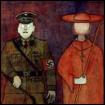
Vatican anti-Judaism versus Nazi anti-Semitism: a subtle theological distinction

To the mediaeval charges against Jews (of "killing Christ", resisting the Truth and hating Christians), in the 19th and 20th centuries the Church in added new ones (of  Bolshevism, capitalist exploitation, rationalism, democracy and secularism). Unlike the Nazis, it generously did not blame them for their genes, however, it was inclined to leave the Jews to their fate.

Mein Kampf, the Vatican censors,
and the subtle theological distinction between “anti-Semitism” and “anti-Judaism”
 

 In 2005 the German Church historian, Hubert Wolf, was allowed into the Vatican Secret Archives. There he discovered that during Hitler’s rise to power Vatican censors, after long deliberation, had consciously decided not to ban Mein Kampf. This, despite the fact that between 1542 and 1966 the Church put more than 5000 books and authors on the Index of forbidden books.

Under threat of punishment, Catholics were not permitted to own or read the banned books. Works by Galileo, Luther, Kant, and Sartre were put on the Index – but nothing by Hitler. Wolf discovered that in 1934 the Church censors, the “Sacred Congregation of the Index”, had got as far as drawing up a list of ten racist sentences that they had found in Mein Kampf. [1] This would ordinarily have led to the book being banned, for the Church officially rejected "racism". Yet in the face of both the threats and the opportunities posed by the Nazis, the Church's opposition to racism remained chillingly theoretical.

Part of the Vatican’s hesitation to act may be due to the subtle distinction between "anti-Semitism", which the Church rejected, and "anti-Judaism", which it seems to have found quite congenial. It didn't condemn the Jews on racial grounds – oh no – it merely objected to them on religious and cultural ones. Although to anyone on the receiving end, the precise reason for the persecution might seem irrelevant, to the Church this was important. After all, it could hardly claim to be universal, (that is to say, “catholic”), unless it formally rejected racism and insisted on the essential equality of mankind. [2]

In practice, the doctrine of human equality meant that if the Jews had been willing to convert en mass to Catholicism, from the Vatican’s point of view that would have solved the "Jewish problem". Unlike the Nazis, the Church felt that there was nothing really wrong with the Jews that conversion wouldn't cure. In other words, whilst the Church blamed the Jews for Bolshevism, capitalist exploitation, rationalism, democracy and secularism, (among others), it did not blame them for their genes – a profound theological distinction, for which the present pope is attempting to take credit.

Yet it's indisputable that Catholic "anti-Judaism" did a great deal to foster Nazi "anti-Semitism". Susan Zucotti attempts to explain the Church's fateful "anti-Judaism":

"Churchmen looking for a scapegoat for modern challenges found it easier to blame outsiders, in this case Jews, than to target countrymen of their own religion. Conditioned by their Church's traditional anti-Judaism for religious reasons, they thought of Jews almost instinctively when searching for an economic, social, and political enemy as well." [3]

Thus for four long years,  while Mein Kampf became required reading throughout Germany – it was even given to all German newlyweds and used as a school textbook – the Vatican officials remained silent. Wolf found evidence “that the censors considered what to do about Hitler, with discussions in the office going on for years and a decision constantly postponed”. Then in 1938 Hitler annexed Austria and the pontiff became increasingly nervous. Once before, invading troops had made the Church stateless and the pope had only recently managed, through a concordat with Mussolini, to win back some of this territory. Now, on the other side of the Alps, his newest concordat partner was building up a war machine.

That was the year the “Sacred Congregation of the Index” quietly – and finally – dropped its investigation. And Wolf, the German Catholic professor who is hoping for further access to the Secret Archives, can't for the life of him imagine why.

— MF  

Further reading: For an excellent short article on the historical-financial aspects of antisemitism, see Catherine Rampell, "Jews and the burden of money", New York Times,  13 January 2010.


Notes

1. Christiane Jacke, "Vatican opens up secrets of Index of forbidden books", Deutsche Presse-Agentur, 22 December 2005. http://news.monstersandcritics.com/europe/article_1070798.php/Vatican_opens_up_secrets_of_Index_of_Forbidden_Books

2.  H. Brand, "The silence of the Vatican and the plight of the Jews",  New Politics, vol. 8, no. 2 (new series), whole no. 30, Winter 2001. This article is brilliant. http://www.wpunj.edu/~newpol/issue30/brand30.htm

3.  Susan Zuccotti, "The Vatican and anti-Semitism", Chapter 1 of Under His Very Windows: The Vatican and the Holocaust in Italy, Yale University Press, 2000. http://www.nytimes.com/books/first/z/zuccotti-windows.html

4. Adolf Hitler, Mein Kampf, Chapter 2. Translation by James Murphy, Hurst and Blackett, London, 1939, p. 46. [This can be found online through a search engine, if desired, but I do not wish to link to the site which posts this book.]


Previous article: Links to two picture collections on the Nazis and the churches Next article: The Judensau (Jews\

More details


Go to Notanant menuWebsite accessibility

Access level: public