



Vatican Bank (Institute for Religious Works) (2014)
Until three international monetary watchdogs began applying pressure, the “murky” IOR had secret accounts, no audits and records destroyed after ten years. To keep using the euro, it agreed in 2009 to submit to the anti-money-laundering laws of the European Union, but has only done the minimum demanded of it. However, it did the maximum to help a priest who was on the run after sexually abusing little boys. It quietly sent him money while stonewalling the British police who were searching for him.
Father Laurence Soper is currently serving an 18-year prison sentence for abusing ten schoolboys at Ealing Abbey in England. When he was arrested in 2016, after five years on the run, police discovered that the monk had been in regular contact with the Vatican Bank and had withdrawn more than £200,000 which the Bank sent to his account in his hideout in Kosovo. [1]
The Vatican's finances can seem as "impenetrable as a thick cloud of incense". A US court described the Vatican Bank as “murky”. [2] It will not reveal its client list; there are no cheque books; everything is done by transfer, by cash or in gold bullion, so as to be untraceable. The perfect setup for money-laundering.
Theoretically account holders are limited priests, religious, Catholic institutions, employees of Vatican City State and diplomats accredited to the Holy See. However, the Vatican refuses to reveal its account holders to outside authorities — and especially to subject itself to scrutiny of past transactions — so no one can test this assertion. “Rumours have long swirled about whether accounts were used as fronts for other interests, including organised crime and Italian politicians”. [3]
Fuel was added to these suspicions in 2013 when a senior accountant in the Vatican financial administration, Monsignor Nunzio Scarano, was arrested and sent to Rome's Queen of Heaven jail. He is known as “Monsignor 500” for his habit of dealing in 500-euro notes, the largest euro banknote printed. The Monsignor is accused of trying to help friends bring 20 million euros into Italy from Switzerland using a government plane to escape detection [4] and burning their mobile phones to hide their plot. He is also under investigation for allegedly trying to launder money from his secret Vatican Bank account by paying cash to friends who were then to pay this into his account at an Italian bank. Only after the Italian authorities stepped in did the Vatican Bank, for the first time in its history, freeze an account — that of Monsignor 500. [5] The Italian judge wrote that the Monsignor saw the Vatican Bank as “the only safe and rapid instrument for financial and banking operations that could evade — if not outright violate — laws against money laundering and tax evasion”. [6] Then a few months later “Monsignor 500” was charged with further crimes -- corruption and money laundering. The Italian authorities seized his luxury, 17-room apartment which was decorated with original artwork and blocked nearly 9.0 million euros ($12 million US) on current accounts linked to him. [7]
Then in 2018 it was announced that not just an accountant, but even a former President of the Vatican was being charged with embezzling more than $61 million through real estate sales. However, this time the matter is being handled by Vatican court not an Italian one. Curiously, it took the Vatican nine years after Angelo Caloia stepped down to start its legal procedings against him. By that time his lawyer, also charged, had reached the age of 94 and the third defendant, a former director general of the Bank, had died. [7b]
The Vatican Bank also has an impenetrable organisation, with three separate boards of directors. And it boasts another curious feature: it was said to be “never audited”, hence funds deposited there could simply vanish without a trace. [8] This bank even maintained that it adopted the remarkable practice of destroying all of its records every ten years. [9]
And, as if the nine-metre thick walls of its tower in the Vatican did not offer enough privacy, “God’s bank” appears to have quietly established itself in the offshore financial centre of the Cayman Islands. [10]
Dodging the Italian financial authorities
As the bank of an independent state, the Vatican Bank escapes scrutiny from Italy. The Bank of Italy suspects that Italians are hiding taxable income in the bank and the Vatican Bank has even admitted that its insistence on special bilateral financial agreements (memoranda of understanding) with specific countries is to shield itself from the Italian financial authorities.
In its report, Moneyval noted that the Vatican was limited in its ability to share financial information with other countries by requiring bilateral agreements to be in place beforehand such as the one signed [with the US on 7 May 2013].
The Holy See insists on the requirement largely because it fears Italy would make unreasonable [!] demands for financial information from the Vatican bank, where Vatican officials, dioceses and members of religious congregations hold accounts. The Bank of Italy suspects Italians are hiding taxable income in the bank. [11]
Other advantages of insisting on setting up diplomatic machinery in advance are the delay this allows -- in the case of the US, the agreement with the US wasn't actually signed until two years later on 7 June 2015. And it is also "believed to be the first intergovernmental agreement between the United States and the Holy See", which can serve as a wedge in the door for a future concordat. [12]
Increased international oversight
The Vatican Bank finally came under pressure from three organisations to conform more closely to international banking rules designed to prevent fraud. In 2013 it issued its first financial report ever. But now it has its own financial accountability body which can is shield it from outside scrutiny.
♦ In 2009, to be able to continue using the euro, the Vatican Bank agreed to submit to the anti-money-laundering laws of the European Union, thus putting itself under the jurisdiction of the European Court of Justice. It updated its agreement with Italy and the European Commission to come closer to conforming to European Union monetary regulations against financial fraud (Article 8) and, at the end of 2010, brought in a Vatican law “approximating” the EU rules, in order to better monitor itself.... [13] (A spokesman has claimed that it is “not a bank in the normal definition of the term” and therefore expects special treatment.) [14]
♦ The Vatican Bank has been in talks with the Organisation for Economic Co-operation and Development which sets transparency standards. However, more than a decade after the OECD began its investigation of tax havens in 1998, the Vatican is still not on its “white list” of countries with a good record on transparency. [15]
♦ The Vatican Bank is also negotiating with the Council of Europe’s Financial Action Task Force (FATF), which imposes measures against money laundering and terrorist financing and is also known as Moneyval. The Vatican promised to adopt the anti-money laundering standards set by the FATF, which obliged it to pass anti-money laundering legislation and set up the equivalent of the Bank of Italy’s Financial Intelligence Unit to monitor the IOR’s activities. [16]
 Tax haven investigation by OECD
The Vatican Bank is effectively “off-shore” from Italy.
IOR does not publish its accounts but is reported to hold €5bn in assets. It provides banking operations for Vatican staff, charitable operations and missions worldwide. It also serves an unknown number of private Italian account holders who use the Vatican as a tax haven. [17]
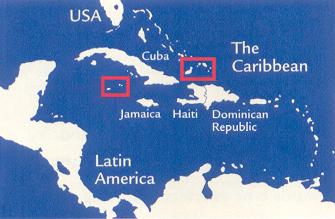
In addition, this “off-shore” tax haven to Italy appears to have further “off-shore” tax havens of its own. Curious is the location of two of the Church’s “independent missions”. These are missions too small to be set up as apostolic prefectures, yet they are still given autonomy, and thus are not part of any diocese. [18] There are nine “independent missions” worldwide, most of them in remote areas with a sparse Catholic population, like Azerbaijan and Tajikistan. [19] However, two of them have been hived off from pre-existing dioceses. These are the Cayman Islands (left) and the Turk and Caicos Islands (right), both of them offshore financial centres.
It is difficult to use pastoral needs to explain the Vatican’s decision to excise the Cayman Islands [in 2000] from its natural Jamaican diocese of Kingston, in order to proclaim them missio sui juris [“independent missions”] under the direct control of the Holy See and entrust them to Cardinal Adam Joseph Maida, a member of the IOR board. [20]
For every person in the Cayman Islands, there are two companies and about five investment funds registered there. [21] In 1998, however, the Organisation for Economic Co-operation and Development began cracking down on tax havens. [22]
Q. What is a tax haven? A. Any country that offers low rates of tax to attract business is to some extent a tax haven. The real problem is that many countries refuse to release details on suspected tax dodgers to other countries. [23]
Even after a decade of prodding by the OECD, the Caymans and Turk and Caicos Islands have remained on the list of “promise to do better” tax havens. [24] Another curious fact is that in 1998, the year the OECD started to examine tax havens, the administration, (and presumably its financial records) of the “independent missions” in the Turk and Caicos Islands was moved from neighbouring Nassau away from the Caribbean to, of all places, Newark, New Jersey. [25] “Due to its proximity to New York, Northern New Jersey in particular has become susceptible to the money laundering industry.” [26] ...Guess where Newark is.
Of course, none of this has stopped the Benedict XVI from attacking tax havens for robbing the poor and laying the blame for the global financial crisis at the door of “offshore centres”. [27]
According to the editors of Lancet, “If international corporations did not channel more than half the world's trade through tax havens, but instead paid local taxes, then 230 deaths in children due to starvation could be prevented each day by the extra revenue.” [28]
Money laundering investigation
The Vatican Bank has used its “less than clear” relationship to the Vatican State to claim “sovereign immunity”. [29] Its connection with the Vatican State has enabled it to avoid having to answer charges in a US court that after WWII it helped hide and launder millions of dollars of concentration camp loot. [30] And it continues ― when convenient ― to assert its immunity from scrutiny as an organ of the Vatican State. Thus in September 2010 a Vatican spokesman claimed that “The IOR is located within the territory of Vatican City State, beyond the jurisdiction and surveillance of various national banks”. [31]
The Vatican's claim to be above international financial scrutiny became harder to maintain when, that same year, an Italian court ruled that the Vatican was a “non-equivalent extracommunitarian country,” thus applying stricter anti-money laundering procedures. [32]
Under these the IOR was discovered to be acting as if it were an Italian bank, thus avoiding scrutiny of certain money transfers. The Italian prosecutor said that in refusing to give an Italian Bank the requested information the Vatican Bank had demonstrated “a deliberate failure to observe the anti-laundering laws with the aim of hiding the ownership, destination and origin of the capital.” [33] Although the Vatican insists this is a “misunderstanding” which can be easily cleared up, an Italian judge has twice upheld the seizure of €23 million ($33 million US) and denied the Vatican’s request for a return of the funds until mid 2011 [34]. In December 2010, three months after the mysterious transaction came to light, an Italian judge criticised the Vatican bank for continuing to hide the identity of its clients. [35]
Additional unrelated cases came to the attention of the Italian police in 2010. In one instance the agent caught shifting mysterious funds for a rich client was a priest. [36] And another priest apparently used the Vatican Bank to help his father launder the €250,000 he had obtained from European Union funding for a non-existent fish farm, a grant which was then withdrawn from his account by an uncle previously convicted for being with the mafia. [37]
2012: The Vatican Bank tries to satisfy the Council of Europe (FATF or Moneyval)
 After the Italians, the Americans began to ask questions about "God's banker". In March 2012 the US State Department for the first time listed the Vatican as potentially vulnerable to money laundering, a notch below those states for which it has solid proof of this. [38] And a few days later the large American bank JP Morgan Chase announced that it was closing the Vatican Bank's account, This account, number 1365, was a “sweeping facility,” meaning that it was emptied out at the end of each day with funds transferred to another IOR account in Germany. Over a period of about 18 months some 1.5 billion euros passed through this mysterious account. [39]
In May, in response to the scandal, the Vatican sacked the bank’s director, Gotti Tedeschi, a member of Opus Dei who had been in charge since 2009. [40]
More bad news came in July when the Council of Europe reported that the Vatican Bank had still not satisfied all the requirements. It had made some progress in satisfying the transparency test of its FATF or Moneyval, but had managed to pass just over half of its obligations ― only 9 of the 16) “key and core” aspects of its financial dealings. Its promises were better than its performance:
The 241-page report found serious problems with the agency's role as a supervisor or regulator of the Vatican's finances, giving it a failing grade. It said the agency had yet to conduct any inspections, can't sanction one of the two key Vatican financial institutions and that its role, authority and independence needed clarification. [...]
The report said the agency's ability to share financial information with other governments was hobbled by the Vatican's insistence that it enter first into bilateral agreements. [41]
This, the Vatican admitted, was to avoid having to hand over information to the Italian authorities who were investigating it. This delaying tactic allowed the Vatican to spirit its money away. In October the Italian police reported that
“the IOR transferred its Italian accounts to the German Deutsche Bank AG,” and lamented that the transfer started when the Bank of Italy “modified the position of the Vatican institute to fulfil anti-money laundering recommendations.” [42]
Yes, the Vatican chose to transfer its money to the very bank that, a couple of months later, faced the first of many convictions for tax evasion and rate-fixing. [43]
Next, from the beginning of 2013 Italy’s Central Bank suspended all bank card payments in the Vatican, obliging tourists to pay for souvenirs with cash or cheques. The Italian banking authorities took this step because they felt that the Vatican Bank had failed to comply with European Union safeguards on finances and hadn't even put in place the banking legislation and proper supervision to do so. [44] Finally in 2015 the Vatican was ready to make a financial agreement with Italy ― to be supervised by the Vatican Secretariat of State, in other words, by itself. [45]
Since this agreement only concerns those who are taxable by Italy, it doesn't address the questions about possible money laundering that were raised in 2013, when it was revealed that the Vatican Bank permits diplomats accredited to it to have secret accounts in its bank. And not just the ambassadors, but also the missions' second and third-ranking diplomats. Some 20 of the 100 countries represented at the Holy See are reported to have taken advantage of this offer. Among these are Syria, Iran, Iraq and Indonesia, whose accounts the Vatican is said to be closing in the face of heightened scrutiny from European banking authorities. The year before information about the Syrian account was leaked from secret US Government files. These involve payments by the murderous Syrian regime of Bashar al-Assad through "God's banker" for civil and military communications systems. [46] The Vatican Bank refused to confirm or deny this report. [47]
The Vatican Bank has been granting the opportunity to launder money to precisely those conservative Muslim regimes that are its allies at the United Nations in attempts to control women. [48]
A new way to shield the Vatican Bank from scrutiny
However the money laundering goes further than the dodgy Monsignor who ended up in Rome's Queen of Heaven jail, or the secret accounts offered to brutal dictators. A potentially much larger sum is involved in the looted assets of Croatian Holocaust victims.
After World War Two, there was a pressing need to move assets from Soviet occupied lands as the Iron Curtain descended on eastern Europe; changing these assets into Church property and depositing it at the Vatican Bank was an effective method however these assets often were commingled with property looted by the Nazis and Axis regimes in Hungary, Romania, Slovakia, and Croatia. [49]
But now demands for an audit that could reveal what happened to this looted gold is being stymied in a new way. The European Commission said that “the question whether the [anti-money laundering] said Monetary Agreement applies to the IOR is still under discussion”. ...But wasn't the whole point of the Agreement to try to prevent the Vatican Bank from engaging in money laundering? [50]
This means that the Vatican's internal Financial Information Authority established in 2010 is acting to shield the Bank from accountability. The lawyer for the Croatian Holocaust victims has been told that the anti-money-laundering treaties with the Vatican do not apply to the Vatican Bank and only the Vatican Financial Authority can call for an audit!
 Bishop: It’s theologically impossible for the Church to launder money
In an unguarded moment in 2005 the Bishop of Aguascalientes and former head of the Education Commission of the Mexican Bishops’ Conference (CEM) revealed how the Church can let the end justify the means. Giving money to the Church, he said, “purified” it. Monsignor Ramón Godínez Flores who had studied theology and canon law in Rome explained that “It is immaterial where the donations from drug trafficking originate and it’s not up to us to investigate the source of the money.” [51]
Bishop Godínez said, “Whatever donations I get, I accept with thanks.” [52] These have become known as “narco-alms” (narco limosnas), which have sometimes extend to the funding of whole “narco-chapels” (narco capillas). One of these even had a plaque naming as its benefactor Lazcano, the bloodthirsty leader of Los Zetas drug cartel who has been connected to some 30,000 murders. [53] Through these donations the gangsters try to purify their souls and avoid punishment in the Hereafter by what they call the “Boss of Bosses” (jefe de jefes).
In 2013 the Vatican Bank was forced by the monetary watchdogs to issue the first annual report in its 125-year history. [54] In the wake of this Cardinal George Pell, the first head of the Vatican's new economy department, admitted that hundreds of millions of euros had been found "tucked away" in accounts of various Holy See departments without having appeared in the city-state's balance sheets. [55] This means that the Vatican is far richer than previously revealed.
The next day the Vatican issued a statement that this did not referr to "illegal, illicit or poorly administered funds". [56] Of course not. Two days later the Vatican admitted that it had launched an investigation against two former executives of the Vatican Bank "for suspected embezzlement of funds". [57]
In 2017 Cardinal Pell had to resign as finance chief and return to his native Australia to face two trials for alleged sex abuse. [58] Then, several months later, an auditor hired by the Vatican to clean up its murky accounts was forced out. This was justified by the Vatican claim that the prominent Italian auditor, Libero Milone, had been been spying on some of the cardinals, a strange allegation that Milone strenuously denied. Even stranger was the Vatican's response to his alleged activities, at least in the eyes of Gianluigi Nuzzi, a journalist put on trial and then acquitted for receiving Vatican documents from a priest.
“The question here is why didn’t the Vatican prosecute Milone?” said Nuzzi. “They accused him of drawing up secret files on prelates then did nothing — it makes no sense until you ask what it is they don’t want to emerge at a trial.” [59]
Why does the Vatican even need a bank?
As a Reuters columnist said,
The best way for the Vatican to come clean would of course be to close the bank: it’s hard to see why it’s needed other than to shroud the Church’s financial dealings in a veil of obsessive secrecy. [60]
And the Italian historian Giorgio Campanini said in the Catholic weekly Famiglia Cristiana that the Vatican Bank should be closed on the grounds that the pontificate shouldn't have direct links to the world of finance. He argued that there are plenty of ethically minded commercial banks in Italy and elsewhere that could be trusted to manage the Holy See's assets. “Total transparency would thus be assured and the faithful, who continue to generously donate, would know that their money given to the church...is destined to the poor.” [61]
But not much chance of that. Instead, in 2013 the Bank's President, Ernst von Freyberg, hired “a team of financial public relations consultants”. [62] Presumably this is Communications & Network Consulting, an international financial PR company with offices, not only in the main financial centres, but also in Abu Dhabi and Dubai. (The Vatican isn't the only one whose financial affairs require whitewashing.) One of their "crisis communications experts" is on hand to give journalists a private tour of the Bank. "Trained as a psychologist as well as in economics", he delivers a smooth patter containing the Vatican's version of the facts interspersed with good "sound bites". [63]
Further reading
Vatican shell trick to avoid financial scrutiny (document)
The Vatican Financial Authority falsely claimed the Vatican Bank was not part of Vatican City therefore did not fall under European Union anti money laundering rules.
Damon Linkermarch, “[Review of] ‘God’s Bankers,’ by Gerald Posner”, New York Times, 20 March 2015. http://www.nytimes.com/2015/03/22/books/review/gods-bankers-by-gerald-posner.html
Brett Arends, “Pope Francis must answer questions about church’s financial dealings with Hitler”, Market Watch, 10 February 2015. http://www.marketwatch.com/story/pope-francis-must-answer-questions-about-churchs-financial-dealings-with-hitler-2015-02-10
Rachel Donadio and Andrew Higgins, “Power Struggle on Reforming Vatican Bank”, New York Times, 9 March 2013. http://www.nytimes.com/2013/03/10/world/europe/power-struggle-on-reforming-vatican-bank.html
Curzio Maltese, “The Secrets of the Vatican Bank” (“Scandali, affari e misteri: tutti i segreti dello Ior”), La Repubblica, 26 January 2008, translated by Graham Hunter.
Elisabetta Povoledo, “Transfer of Vatican Official Who Exposed Corruption Hints at Power Struggle”, New York Times, 26 January 2012. http://www.nytimes.com/2012/01/27/world/europe/archbishop-viganos-transfer-hints-at-vatican-power-struggle.html
Press release about the latest Moneyval report on the Vatican Bank, 2013-12-12. http://www.zenit.org/en/articles/council-of-europe-committee-releases-report-on-vatican-measures-to-combat-money-laundering
Notes
1. “Vatican ‘withheld whereabouts of Ealing abbot on run over child abuse’”, Times, 2019-02-07.
https://www.thetimes.co.uk/article/vatican-withheld-whereabouts-of-ealing-abbey-abbot-on-run-over-child-abuse-st-benedicts-bjbbrcbs6
2. Judgement of the Ninth U.S. Circuit Court, 2005-04-12. “Court clears way for suit against the Vatican Bank for Nazi gold”, San Jose Business Journal, 2005-04-18. http://www.bizjournals.com/sanjose/stories/2005/04/18/daily9.html
3. “Cleric and 2 Others Arrested in Vatican Bank Investigation”, New York Times, 2013-06-28. http://www.nytimes.com/2013/06/29/world/europe/cleric-and-2-others-arrested-in-vatican-bank-investigation.html
4. “Vatican Freezes Account of Monsignor 500 after Money Laundering Scandal”, International Business Times, 2013-07-12. http://www.ibtimes.co.uk/articles/489568/20130712/nunzio-scarano-vatican-freezes-account-monsignor-500.htm
5. “Vatican, US Treasury agree to share financial data”, AP, 2013-05-07.
http://bigstory.ap.org/article/vatican-us-treasury-agree-share-financial-data
6. “Arrested Vatican monsignor felt he could act with impunity: judge”, Reuters, 2013-06-30. http://www.reuters.com/article/2013/06/30/us-vatican-bank-idUSBRE95T08220130630
7. “Ex-Vatican accountant allegedly used donations for the poor in money laundering scheme”, Agence France-Presse, 2014-01-21. http://www.rawstory.com/rs/2014/01/21/ex-vatican-accountant-allegedly-used-donations-for-the-poor-in-money-laundering-scheme/
Of Virtue and Vice, and a Vatican Priest”, New York Times, 2014-10-18. http://www.nytimes.com/2014/10/19/business/of-virtue-and-vice-and-a-vatican-priest.html
7b. “Vatican Bank’s Ex-Chief Indicted Over $60 Million in Embezzlement Losses”, New York Times, 2018-03-03. https://www.nytimes.com/2018/03/03/world/europe/vatican-bank-embezzlement-indictment.html
8. “Declaration of Avvocato (lawyer) Franzo Grande Stevens in support of defendant IOR's (Institute for Religious Works', i.e., Vatican Bank's) motion to dismiss plaintiff's third amended complaint”, 2000-10-30, Turin, Case No. C-99-4941 MMC, United States District Court, Northern District of California, § 21, “It is the custom and practice of the IOR not to retain records after ten years”. http://www.vaticanbankclaims.com/vatpr.html
9. Monetary Agreement between the European Union and the Vatican City State, 2009-12-17, Article 8 and the Annex. http://ec.europa.eu/economy_finance/euro/world/outside_euro_area/documents/2010-01-01-vatican_monetary_agreement.pdf
10. “The Secrets of the Vatican Bank”, translated from La Repubblica, 2008-01-26.
http://www.concordatwatch.eu/showdoc.php?org_id=843&doc_id=1821
11. Nicole Winfield, "Vatican, US Treasury agree to share financial data", AP, 2013-05-07.
http://bigstory.ap.org/article/vatican-us-treasury-agree-share-financial-data
12. "FATCA Update: Tax Evaders Don’t Have a Prayer", Thomson Reuters, 2015-06-16. http://www.accountingweb.com/tax/irs/fatca-update-tax-evaders-dont-have-a-prayer
A Vatican source, however, claims that this agreement is "building on a series of Vatican-U.S. accords", but doesn't mention what they might be.
"Holy See, U.S. sign historic accord against tax evasion", Vatican Radio, 2015-06-10. http://en.radiovaticana.va/news/2015/06/10/holy_see,_us_sign_historic_accord_against_tax_evasion___/1150442
13. John Loftus, former US Department of Justice prosecutor with the Nazi-hunting OSI unit, quoted by Jonathan Levy, “The Vatican Bank”, ed. Russ Kick, Everything You Know Is Wrong: The Disinformation Guide to Secrets and Lies, 2002, p. 19.
http://books.google.com/books?id=T75G7hLlk80C&pg=PA19&lpg=PA19&dq=loftus+%22osi+unit%22&source=web&ots=ABfGVLzusl&sig=SeGIC9RubNBDZGHwzRXVsUEh96U#PPA20,M1
14. EU Directives are not directly applicable end even EU states (which the Vatican is not) must transpose the requirements into their national legislation.
Jeffrey Donovan and Lorenzo Totaro, “Pope to Bind Vatican to Money-Laundering Law, EU Says”, Bloomberg News, 2010-10-29. http://www.bloomberg.com/news/2010-10-29/-papal-act-set-to-commit-the-vatican-to-money-laundering-laws-eu-says.html
15. “Vatican Finances Aboveboard, Affirms Aide”, Zenit, 2010-09-23. http://www.zenit.org/article-30465?l=english
16. Guy Dinmore, “The Vatican: A murky See”, Financial Times, 2010-09-24. http://www.ft.com/cms/s/0/4c7e5606-c802-11df-ae3a-00144feab49a.html#axzz150QiGLfh
17. Guy Dinmore, “Sicily probe adds to Vatican bank pressure in Rome”, Financial Times, 2010-11-03. http://www.ft.com/cms/s/0/3a207e64-e736-11df-880d-00144feab49a.html#axzz14zXPKrYj
18. “Sui iuris” http://www.statemaster.com/encyclopedia/Sui-iuris
19. Catholic Dioceses in the World by Type: Independent Missions (Missions “sui iuris”) http://www.gcatholic.com/dioceses/data/type-miss.htm
20. Paul Collins, "Vatican Bank and Cayman Islands", Angie’s Diary, 2012-02-27.
https://angiesdiary.com/articles/vatican-bank-and-cayman-islands/
21. Iain Dey, “Last orders: Is the sun about to set on tax havens?” The Times, 2009-03-08. http://business.timesonline.co.uk/tol/business/industry_sectors/banking_and_finance/article5864693.ece
22. “Harmful Tax Competition: An Emerging Global Issue” [title of OECD report, 1998], Wikipedia. http://en.wikipedia.org/wiki/Harmful_Tax_Competition:_An_Emerging_Global_Issue
23. Iain Dey, “Last orders: Is the sun about to set on tax havens?” The Times, 2009-03-08. http://business.timesonline.co.uk/tol/business/industry_sectors/banking_and_finance/article5864693.ece
24. Willem Buiter, “Non-doms and tax havens: the Chancellor’s good fortune”, Financial Times, 2008-02-29. http://blogs.ft.com/maverecon/2008/02/non-doms-and-tax-havens-the-chancellors-good-fortune/ Officially it’s called “Jurisdictions Committed to Improving Transparency and Establishing Effective Exchange of Information in Tax Matters”.
25. “Roman Catholic Mission Sui Iuris Of Turks And Caicos” http://www.servinghistory.com/topics/Roman_Catholic_Mission_Sui_Iuris_of_Turks_and_Caicos
26. James B. Johnston, “An Examination of New Jersey’s Money Laundering Statutes”, Seton Hall Legislative Journal, Vol. 30.1, 2005, p. 2. http://works.bepress.com/cgi/viewcontent.cgi?article=1004&context=james_johnston
27. “Pope attacks tax havens for robbing poor”, Guardian, 2008-12-07. http://www.guardian.co.uk/world/2008/dec/07/pope-benedict-vatican-tax-havens-credit-crunch
28. “Hunger: enough is enough”, Lancet editorial, Volume 381, Issue 9864, Page 348, 2013-02-07. http://www.thelancet.com/journals/lancet/article/PIIS0140-6736(13)60150-6/fulltext
29. Judgement of the Ninth U.S. Circuit Court, 12 April 2005. “Court clears way for suit against the Vatican Bank for Nazi gold”, San Jose Business Journal, 2005-04-18. http://www.bizjournals.com/sanjose/stories/2005/04/18/daily9.html
30. “Lawsuit charges that Nazi gold funded Vatican ratlines”, Concordat Watch. http://www.concordatwatch.eu/showtopic.php?org_id=890&kb_header_id=6151
31. “Vatican Finances Aboveboard, Affirms Aide”, Zenit, 2010-09-23. http://www.zenit.org/article-30465?l=english
32. "Vatican finance group signs agreement with German counterpart", Catholic News Agency, 2013-12-04.
http://www.patheos.com/blogs/catholicnews/2013/12/vatican-finance-group-signs-agreement-with-german-counterpart/
33. “Prosecutors: Vatican Bank Defying Laundering Laws”, The Associated Press, 2010-10-22. http://www.salon.com/2010/10/22/vatican_bank/
34. “Vatican's Move to Financial Transparency Rewarded”, Zenit, 2011-06-02. http://www.zenit.org/e-32737
35. “Italian judge upholds seizure of Vatican assets”, The Associated Press, 2010-12-20. http://www.msnbc.msn.com/id/40754048/ns/world_news-europe/
“Vatican bank sets up money-laundering unit hoping to escape scandal”, Guardian, 2010-12-29. http://www.guardian.co.uk/world/2010/dec/29/vatican-bank-money-laundering-authority
“Vatican Creates Financial Watchdog”, The Associated Press, 2010-12-30. http://www.nytimes.com/aponline/2010/12/30/world/europe/AP-EU-Vatican-Bank.html
“Pope acts to tackle money-laundering in Vatican”, Agence France Press, 2010-12-31. http://uk.news.yahoo.com/18/20101230/tbs-pope-acts-to-tackle-money-laundering-5268574.html
36. Lorenzo Totaro, “Vatican Bank Probe Extended to Suspect Clergymen Accounts, Corriere Says”, Bloomberg News, 2010-10-21. http://www.bloomberg.com/news/2010-10-21/vatican-bank-probe-extended-to-suspect-clergymen-accounts-corriere-says.html
37. Guy Dinmore, “Sicily probe adds to Vatican bank pressure in Rome”, Financial Times, 2010-11-03. http://www.ft.com/cms/s/0/3a207e64-e736-11df-880d-00144feab49a.html#axzz14zXPKrYj
38. “US sees Vatican as potential money laundering hub”, AFP, 2012-03-07. http://news.yahoo.com/us-sees-vatican-potential-money-laundering-hub-235850767.html
The 2012 International Narcotics Control Strategy Report (volume 2) has three categories for the list of 190 countries vulnerable to money-laundering activities: of primary concern, of concern and monitored. The Vatican has been placed in the second category, "of concern". (pp. 31, 33) https://www.hsdl.org/?view&did=702517
39. “Vatican bank image hurt as JP Morgan closes account”, Reuters, 2012-03-19. http://uk.reuters.com/article/2012/03/19/uk-vatican-bank-idUKBRE82I0P820120319
“'Cliente a rischio'. JPMorgan chiude il conto dello Ior”, Il sole 24 ore, 2012-03-18. http://www.ilsole24ore.com/art/finanza-e-mercati/2012-03-18/morgan-chiude-conto-143759.shtml
40. “God’s bankers:A beleaguered papacy is embroiled in intrigue. Some scent a succession struggle”, Economist, 2012-07-07. http://www.economist.com/node/21558249
Sandro Magister, “The Hunt for Thieves in the Vatican”, Chiesa, 2012-05-31. http://chiesa.espresso.repubblica.it/articolo/1350256?eng=y
“Cardinals split on whether to sack head of Vatican Bank”, AFP, 2012-06-02. http:/www.thejournal.ie/cardinals-split-on-whether-to-sack-head-of-vatican-bank-472636-Jun2012/
41. “Vatican Passes Key Financial Transparency Test”, Associated Press, 2012-07-18. http://abcnews.go.com/International/wireStory/report-card-vatican-transparency-released-16799879
The press release fo the COE itself carries a less sanguine title:
“Council of Europe report calls on the Holy See to strengthen supervisory regime”, Council of Europe, 2012-07-18. https://wcd.coe.int/ViewDoc.jsp?Ref=DC-PR079(2012)&Language=lanEnglish&Ver=original&Site=DC&BackColorInternet=F5CA75&BackColorIntranet=F5CA75&BackColorLogged=A9BACE
See also:
Mutual Evaluation Report – Executive Summary
Anti-Money Laundering and Combating the Financing of Terrrorism
The Holy See (including Vatican City State) 2012-07-04.
http://www.coe.int/t/dghl/monitoring/moneyval/Evaluations/round4/MONEYVAL(2012)17_MER_HS_en.pdf
Mutual Evaluation Report – Annexes
Anti-Money Laundering and Combating the Financing of Terrrorism
The Holy See (including Vatican City State) 2012-07-04.
http://www.coe.int/t/dghl/monitoring/moneyval/Evaluations/round4/MONEYVAL(2012)17ANN_HS_en.pdf
42. "Vatican finance group signs agreement with German counterpart", Catholic News Agency, 2013-12-04.
http://www.patheos.com/blogs/catholicnews/2013/12/vatican-finance-group-signs-agreement-with-german-counterpart/
43. "Deutsche Bank convicted in Italy in widening scandal", EU Observer, 2012-12-12.
http://euobserver.com/economic/118581
"Deutsche Bank CO2 Trade Partner Convictions Upheld by Top Court", Bloomberg, 2013-01-14.
http://www.bloomberg.com/news/2013-01-14/deutsche-bank-co2-trade-partner-convictions-upheld-by-top-court.html
"Barclays and Deutsche Bank lose Libor appeal", Reuters, 2013-11-09.
http://www.theguardian.com/business/2013/nov/09/barclays-deutsche-bank-libor-appeal
44. "Italy Shuts Off Credit Card Payments In Vatican", Economy Watch, 2013-01-03. http://www.economywatch.com/in-the-news/italy-shuts-off-credit-card-payments-in-vatican.04-01.html
45. [The Vatican hasn't released the text and has only given out fragmentary information about this agreement with Italy over the course of a year-and-a-half, hence the three references below.]
"Holy See and Italy sign agreement on fiscal cooperation", Vatican Radio, 2015-04-01.
http://en.radiovaticana.va/news/2015/04/01/holy_see_and_italy_sign_agreement_on_fiscal_cooperation/1133862
"Vatican Bank: Haven For Money Laundering & Tax Evasion No More", International Busoness Times, 2015-04-07. http://www.ibtimes.com.au/vatican-bank-haven-money-laundering-tax-evasion-no-more-1436684
"Vatican advances financial clean-up with Italian tax deal", Catholic News Service, 2016-10-17. https://cruxnow.com/vatican/2016/10/17/vatican-advances-financial-clean-italian-tax-deal/
46. "Riciclaggio, la banca del Vaticano chiude i conti di 4 ambasciate", Corriere della sera, 2013
-10-01. http://roma.corriere.it/roma/notizie/cronaca/13_ottobre_1/riciclaggio-Ior-chiude-conti-ambasciate-2223389963163.shtml
This mentions information from the Syria Files which WikiLeaks began publishing on 2012-07-05, more than two million emails from Syrian political figures, ministries and associated companies, dating from August 2006 to March 2012: http://wikileaks.org/syria-files/
47. "Seeking transparency, Vatican Bank issues first annual report", Catholic News Agency, 4 October 2013-10-04. http://www.catholicnewsagency.com/news/seeking-transparency-vatican-bank-issues-first-annual-report/
48. Rowan Harvey, "UN conference on women: some rights won, but more battles ahead", Guardian, 2013-03-20. http://www.guardian.co.uk/global-development/poverty-matters/2013/mar/20/un-conference-women-rights-won
49. Jonathan Levy, “Vatican continues to block audit of Holocaust looted assets: EU Says it Lacks Authority to Intervene”, 2013-12-13. http://www.scribd.com/doc/191243344/VATICAN-CONTINUES-TO-BLOCK-AUDIT-OF-HOLOCAUST-LOOTED-ASSETS
50. European Commission Ombudsman to Dr Jonathan Levy, 2013-10-24. http://www.scribd.com/doc/191241446/EU-Response-on-Vatican-Bank-Holocaust-Assets
51. “México: Obispo acepta que Iglesia reciba narcolimosnas”, Reuters, 2005-09-21. http://archivo.abc.com.py/2005-09-21/articulos/205752/mexico-obispo-acepta-que-iglesia-reciba-narcolimosnas
52. “La Iglesia católica dice purificar las limosnas del narcotráfico en México”, AFP, 2005-09-20. http://www.absurddiari.com/s/llegir.php?llegir=llegir&ref=7837
53. “Narcolimosnas – alms from drug cartels infect the Mexican Catholic church”, Borderzine, 2012-12-27. http://borderzine.com/2012/12/narcolimosnas-%E2%80%93-alms-from-drug-cartels-infect-the-mexican-catholic-church/
“Iglesia y narco en México: entre la amenaza y la complicidad”, BBC, 2012-03-22. http://www.bbc.co.uk/mundo/noticias/2012/03/120322_mexico_iglesia_narco_visita_papa_aw.shtml
54. “In move to transparency, Vatican bank issues first report”, Reuters, 2013-10-01. http://www.reuters.com/article/2013/10/01/us-pope-bank-idUSBRE9900HS20131001
55. “Vatican finds hundreds of millions of euros 'tucked away': cardinal”, Reuters, 2014-12-04. http://www.reuters.com/article/2014/12/04/us-vatican-economy-pell-idUSKCN0JI1CG20141204
Cardinal George Pell, “The days of ripping off the Vatican are over”, Catholic Herald, 2014-12-04. http://www.catholicherald.co.uk/issues/december-5th-2014/the-days-of-ripping-off-the-vatican-are-over/
56. “Holy See Comments on Financial Reforms Article by Cardinal George Pell”, Zenit, 2014-12-05. http://www.zenit.org/en/articles/holy-see-comments-on-financial-reforms-article-by-cardinal-george-pell
57. “Director of the Holy See Press Office on the inquiry on two ex-executives of the IOR”, Vatican Information Service, 2014-12-07. http://visnews-en.blogspot.no/2014/12/director-of-holy-see-press-office-on.html
58. “Cardinal George Pell to face two trials for sexual abuse”, Times, 2018-05-02. https://www.thetimes.co.uk/article/cardinal-george-pell-ordered-to-face-trial-for-sexual-abuse-fq256bmfk?shareToken=aad0841e89505ac7acf977a7f254d798
59. “Spy scandal engulfs Libero Milone, the expert brought in to clean up Vatican”, Times, 2017-10-03. https://www.thetimes.co.uk/article/spy-scandal-engulfs-libero-milone-the-expert-brought-in-to-clean-up-vatican-k8zw065pf?shareToken=7f1026070fbc995c1d7422c7583be089
60. Pierre Briancon, Reuters blog, 2012-03-21. http://blogs.reuters.com/breakingviews/2012/03/21/vatican-bank-struggles-to-be-cleansed-of-past-sins/
61. “Giorgio Campanini: basta con lo Ior, sì alle banche etiche”, La Stampa, 2013-03-06.
http://vaticaninsider.lastampa.it/news/dettaglio-articolo/articolo/chiesa-church-iglesia-22930/
62. “In move to transparency, Vatican bank issues first report”, Reuters, 2013-10-01. http://www.reuters.com/article/2013/10/01/us-pope-bank-idUSBRE9900HS20131001
63. Paul Vallely, Can Pope Francis clean up God’s bank? Guardian, 2015-08-13. (Adapted from Pope Francis: Untying the Knots – The Struggle for the Soul of Catholicism, 2015). http://www.theguardian.com/world/2015/aug/13/can-pope-francis-clean-up-gods-bank


